Sourced fact
The News
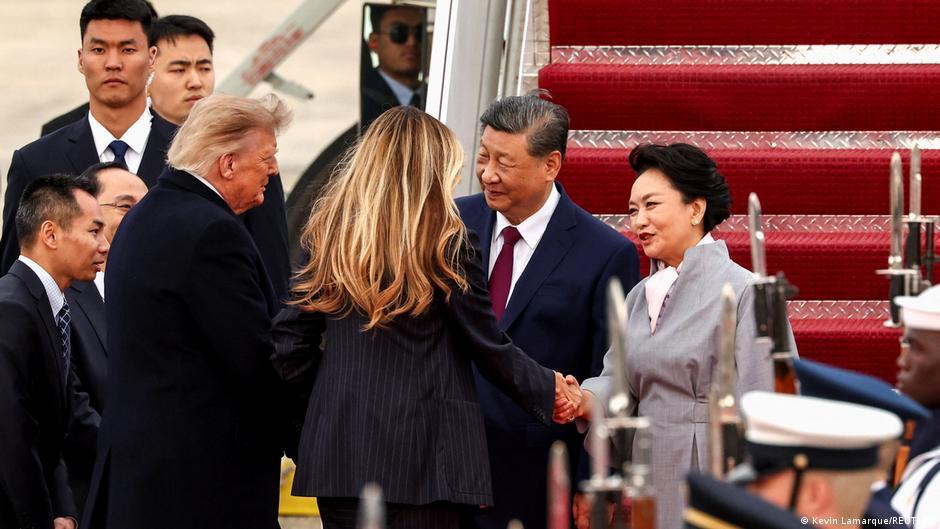
Chinese President Xi Jinping's visit to the United States concluded after three days of negotiations with President Donald Trump, without achieving any breakthrough in trade tensions or major issues. At the end of the visit, leaders met at the White House, where President Trump and his wife, Melania, greeted Chinese President Xi and his wife, Li Yuanyuan, for tea before a trip to the National Archives. News headlines highlighted President Trump's confirmation of two additional summits with his Chinese counterpart this year: one in November in China and another at the G20 summit in Florida in December.
President Trump described the meeting as a "summit of friendship, strength, and success" for both nations, noting that both sides had made significant progress and would continue to communicate intensively through ongoing conversations. On his part, Xi stated that US-China relations must be based on strategic stability grounded in mutual respect, equality, and mutual benefit, reaffirming his desire to host President Trump and his wife for a visit to China soon. He also added that both parties agreed to add new content to their bilateral relations to enhance and develop them mutually.
Regarding trade tensions, U.S. Trade Representative Robert Lighthizer revealed details of new trade negotiations involving exemptions for some key goods from current trade disputes. He indicated that the United States would export agricultural products and medical devices while importing other non-sensitive consumer goods from China, excluding high-quality electronic chips requiring special licenses. These developments follow the U.S. raising tariffs on Chinese goods in April to 145%, prompting China to respond with retaliatory tariffs up to 125%.
Leaders also discussed Iran's war and the closure of the Strait of Hormuz during their meeting. Trump confirmed they had discussed these issues and expected significant progress in this area. He added that both sides agreed to a temporary suspension of new tariffs for 90 days before reaching a comprehensive trade deal in October, which was originally scheduled to end in November. At the conclusion of the visit, Xi left Washington after touring the National Archives, which houses historical documents such as the Declaration of Independence and the Constitution, while hundreds of protesters gathered near the White House opposing the visit and calling for religious and freedom rights in regions like Tibet and Hong Kong.
Analysis & context
Analysis & Context
From an analytical perspective, despite mutual optimism among leaders about "huge progress," reports indicate no fundamental breakthrough on thorny issues such as trade tensions or AI regulation. This delicate balance reflects the complex nature of international relations, where each party seeks to advance its interests without compromising core principles in the face of domestic and foreign public opinion.
In a broader context, this summit is part of a strategy to redefine relations between the world's two largest economies after a period of mutual escalation via tariffs and technical restrictions. The visit comes at a time when the region faces multiple geopolitical tensions, including those in the Middle East, Ukraine, and the Korean Peninsula, making bilateral cooperation vital for global stability.
Additionally, the summit saw notable participation from American technology sector leaders such as Elon Musk and Mark Zuckerberg, highlighting the importance of integrating the private sector into the new diplomatic agenda. This trend reflects a shift toward a broader cooperation model encompassing multiple sectors beyond traditional diplomacy, including the digital economy and technological innovation.
Finally, despite official celebrations, protests outside the White House continued, calling for human rights in regions such as Tibet, Shanghai, and Taiwan, underscoring the gap between official diplomatic rhetoric and the internal social realities of both countries.