Sourced fact
The News
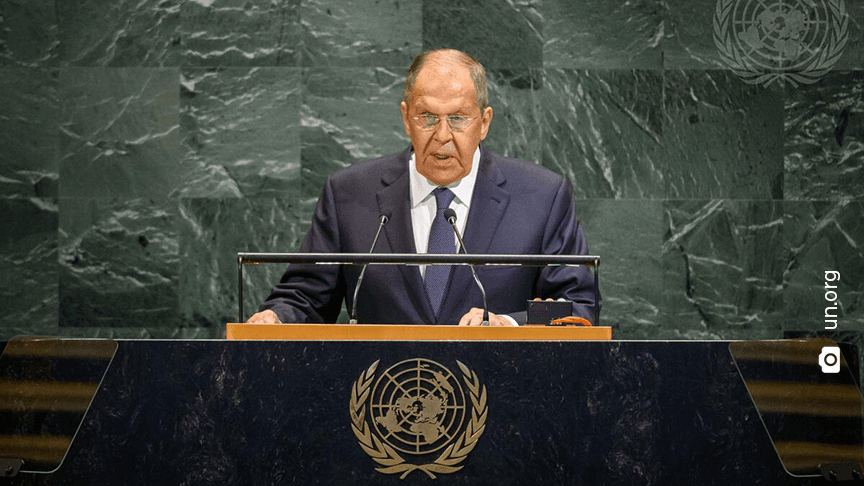
On Saturday, Russian Foreign Minister Sergey Lavrov accused the West on Saturday of trying everything possible to prevent peace talks between Russia and Ukraine during his address at the United Nations General Assembly in New York. Lavrov stated that European countries are doing everything within their power to thwart peace opportunities, considering that the West seeks a strategic defeat for Russia but will eventually end up in a strategic dead end.
Lavrov also accused the West of supplying arms to Ukraine and aiding Kyiv in targeting civilians and civilian infrastructure using drones and missiles. In another context, the Russian minister called on the United States to immediately release former Venezuelan President Nicolas Maduro and his wife, describing the use of force to kill late Iranian Revolutionary Guard Corps commander Ayatollah Ali Khamenei as unacceptable.
When Lavrov moved to Middle East issues, he affirmed that Moscow is convinced that the time has come to resolve the region's main issue by ensuring the establishment of a Palestinian state based on numerous United Nations resolutions. He also endorsed China's initiative to create a global organization for artificial intelligence cooperation, reflecting Russia's trend toward enhancing international collaboration in this sensitive field.
Analysis & context
Analysis & Context
Analytically, Lavrov's speech at the UN General Assembly represents a diplomatic escalation focused on holding the West responsible for the continuation of the war in Ukraine through supplying it with weapons used against civilians. This speech reflects a shift in Russian diplomatic narrative moving from focusing on self-defense to accusing Western powers of direct interference in neighboring countries' affairs.
In a broader context, Lavrov's position on the Middle East emerges as part of a comprehensive Russian strategy aimed at reshaping regional and international balances. The call to resolve the Palestinian issue and release the Venezuelan president indicates Moscow's desire to enhance its influence as an international power capable of impacting multiple files beyond the limits of Europe and Central Asia.
Additionally, Russia's support for China's initiative on establishing a global organization for artificial intelligence cooperation reflects a strategic alliance between the two countries to counter Western dominance in modern technological fields. This alliance aims to build an alternative to prevailing Western standards in regulating and developing global artificial intelligence technologies.
Finally, the timing of these accusations at the UN General Assembly highlights the importance of the international platform in spotlighting issues Moscow sees as threatening its interests or national security. Using sharp language against the West aims to break Russia's diplomatic isolation and draw international community attention to what Moscow calls Western bias against Russia and its allies.