Sourced fact
The News
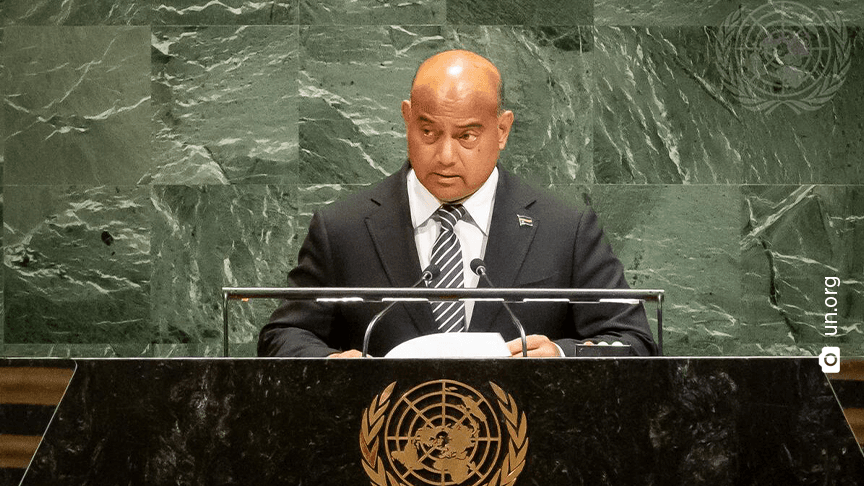
The President of the Pacific Island nation of "Nauru" (which officially changed its name from Nauru to Nauru in July) announced before the United Nations General Assembly in New York that his country is withdrawing from the International Criminal Court. President David Adeang stated that Nauru will deposit the withdrawal document with the Rome Statute Depositary before leaving New York, describing the court as a multilateral institution whose importance has become increasingly questioned.
This announcement came immediately after a speech by US President Donald Trump to the General Assembly on Tuesday, in which he urged member states to withdraw from the International Criminal Court. Nauru's decision coincided with its political history at the UN, where the state has regularly voted with the United States on issues concerning Israel and Palestine, including rejecting the 2025 resolution supporting a two-state solution.
Furthermore, President Adeang addressed economic and environmental issues during his address, calling for an end to delays in establishing international rules for seabed mining, warning that failure to adopt these rules could lead countries to take unilateral actions. He also called for reforming the Security Council to reflect the current world reality rather than the situation in 1945, and urged the World Bank to consider the fragility of countries when determining their eligibility for financial support.
Analysis & context
Analysis & Context
Analytically, Nauru's decision to withdraw from the International Criminal Court represents a fundamental shift reflecting increasing political pressure on the international judicial institution, especially in light of public speeches by world leaders such as US President Donald Trump. This withdrawal is not an isolated event but part of a broader wave of skepticism regarding the effectiveness and independence of the International Criminal Court in dealing with complex global issues.
In the wider context, President Adeang's demands for Security Council reform reflect a growing desire among developing and island nations to restructure the international system to better represent current geographical and political realities. Historically, the Security Council has represented a power distribution from the mid-20th century, prompting many countries to condemn its imbalance and the need to expand both permanent and non-permanent membership.
Additionally, the President's remarks on seabed mining highlight an escalating global debate over natural resource rights in high seas, where Pacific Island nations seek to secure their economic interests before international agreements may slow down development progress. This balance between national sovereignty and international commitments remains a persistent challenge in contemporary international relations.
Finally, the President's call to end sanctions against Cuba and the necessity of dialogue based on full respect for sovereignty reflects diplomatic orientations aimed at reducing geopolitical tensions and enhancing regional and global stability through traditional diplomatic channels and mutual respect between states.