Sourced fact
The News
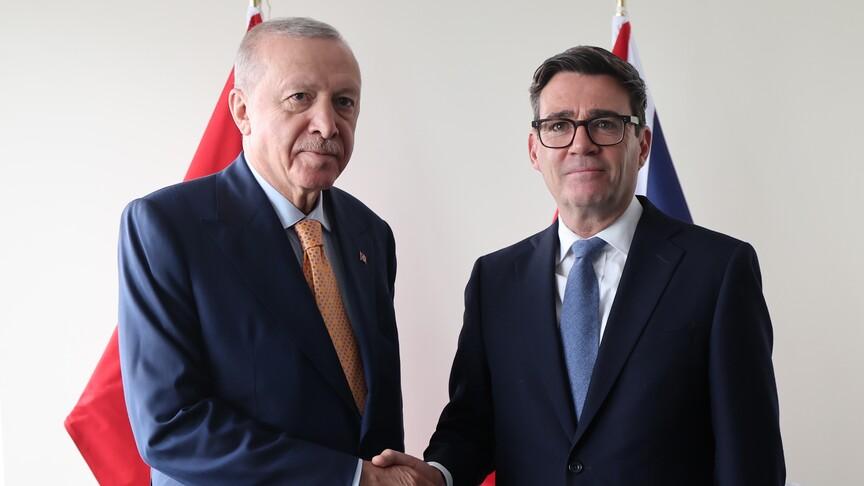
Turkish President Recep Tayyip Erdoğan met with British Prime Minister Andrew Burnham in their first face-to-face encounter to discuss regional and global issues and bilateral relations, on the sidelines of the 91st United Nations General Assembly held on Tuesday in Istanbul.
President Erdoğan clarified that relations between the two countries are experiencing comprehensive strengthening across all fields, with a focus on enhancing cooperation in the defense and commercial trade sectors through joint practical steps. He also pointed out that escalating tensions in Iran and Ukraine require international efforts to restart peace negotiations, particularly regarding the passage of commercial ships through the Strait of Hormuz.
The Turkish President emphasized the need for international pressure to compel Israel to stop its ongoing aggression in Gaza and the occupied West Bank, affirming that Tel Aviv is not seeking peace through its repeated actions. Regarding Cyprus, Erdoğan clarified that no results will be achieved from any proposed formula unless recognition is given to the sovereign equality and international status of Greek Cypriots.
Several senior Turkish officials attended the meeting, including Foreign Minister Hakan Fidan, Finance Minister Mehmet Simsek, and Chief Advisor Akif Çağatay Kılıç. Erdoğan described the situation in Ukraine as having fallen into a deadlock due to targeted attacks on Turkish and foreign ships in the Black Sea.
Analysis & context
Analysis & Context
From an analytical perspective, this meeting between Erdoğan and Bernham represents a significant milestone in redefining the political dynamics between Ankara and London, especially given the changing global geopolitical landscape and its impact on NATO policies. The shared focus on issues such as the Strait of Hormuz and Ukraine reflects a trend toward regional coordination to address common security challenges that threaten the stability of the region and the world.
In a broader context, Turkey's straightforward stance on Cyprus and Israel highlights the independence of Turkish foreign policy in handling sensitive files away from traditional Western pressures. Moreover, the emphasis on cooperation in the defense sector indicates Turkey's desire to diversify its strategic partners and reduce single-dependence in national security matters.
As for Ukraine, Erdoğan's description of the situation as a "deadlock" reflects his deep understanding of the crisis's depth and its impact on European security, where any progress on the Hormuz Strait file could be a key to reactivating international dialogue around Ukraine. This approach underscores Turkey's role as a pivotal mediator in multi-dimensional files that bridge the Middle East, Europe, and Central Asia.