Sourced fact
The News
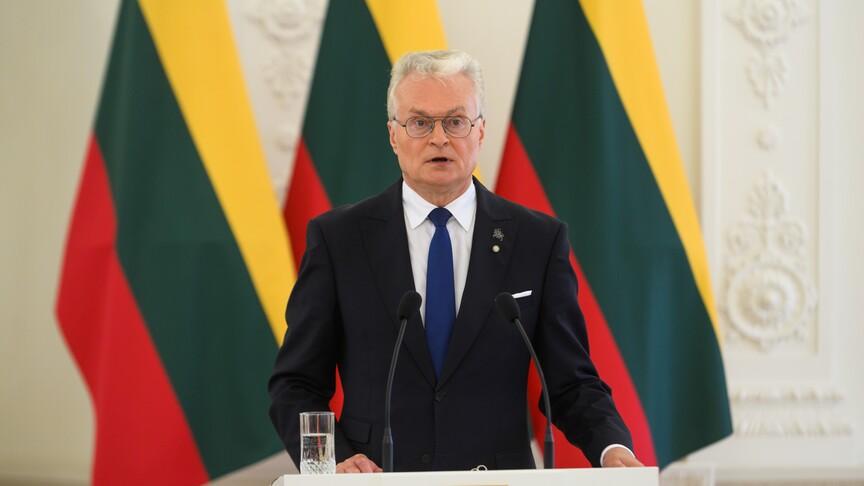
Lithuanian President Gitanas Nausėda reaffirmed in his address to the United Nations General Assembly in New York on Tuesday that a two-state solution is the only path to achieving lasting and comprehensive peace in the Middle East. He called for allowing humanitarian aid to flow safely to the needy residents of Gaza without any obstacles, while emphasizing his country's support for international efforts aimed at maintaining the ceasefire in the sector.
Nausėda also pointed to the comprehensive plan to end the conflict in Gaza, which includes deploying a temporary international stabilization force that provides necessary guidelines for action. He reiterated the importance of completely disarming non-state armed groups. In discussing the Russia-Ukraine war, which began with a full-scale invasion in February 2022, the Lithuanian President described Russia as the greatest threat to the global order and the biggest risk to Europe, Africa, and Asia due to its imperial ambitions.
Nausėda stated that the current phase of the war has lasted longer than World War I, noting that Russia has suffered over 1.5 million military casualties in exchange for gaining only 0.3% of Ukraine's territory. He added that all these efforts and bloodshed were in vain because Ukraine still stands as a proud independent state, considering that Russia has already lost the war despite its repeated violations of European airspace using drones.
He also warned of the increasing dangers posed by the use of artificial intelligence in military and hybrid operations, calling for not determining the future of this technology through authoritarian control, technological coercion, or malicious use of data.
Analysis & context
Analysis & Context
From an analytical perspective, President Nausėda's stance at the UN General Assembly highlights Lithuania's ongoing strategy to unite the world against what it terms "Russian imperial threats," especially with the continuation of the war in Ukraine and its impact on European security. The repeated assertion that Russia has lost the war despite ongoing combat reflects a shift in international discourse toward recognizing Russia's actual strategic failure before Ukrainian resistance and Western support.
In a broader context, the President highlights new threats posed by modern technologies such as artificial intelligence and hybrid attacks, which have become key tools in information warfare and sabotage against European infrastructure and airspace. Linking AI use to authoritarian control and malicious data usage reflects growing concern among Western states about regime-dominated systems seizing future technologies.
The discussion on Russian drone violations of European airspace serves as concrete evidence of the war's expansion beyond Ukraine, making Europe a direct participant in Russia's conflict with the free world. This broadened definition of security threats explains why Lithuania and other European countries focus on strengthening cyber defense and air surveillance to face these increasing challenges.
Finally, linking the Gaza issue with the Ukraine issue in a single UN address reflects a Lithuanian vision that global peace can only be achieved by addressing all major conflict files simultaneously, starting from ending Russian aggression to reaching a just resolution of the Israeli-Palestinian conflict.