Sourced fact
The News
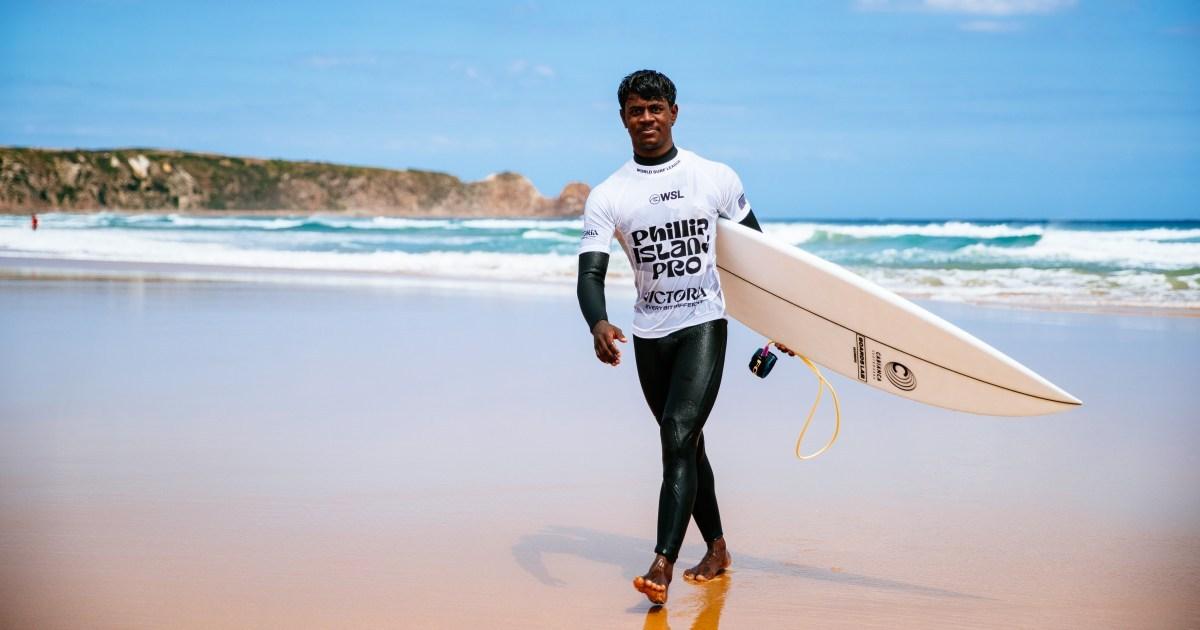
The arrival of the Indian swimming team at the upcoming Asian Games in Japan next month marks a historic achievement after wave sports evolved from a marginal hobby into an organized sport thanks to the efforts of successive generations. Four Indian prisoners, including two girls named Sujar Panaris and Kamali Murti, are competing for the first time in these Games hosted by Japan between this Friday and next Tuesday.
Reports indicate that the team consists of 20-year-old Panaris and 16-year-old Murti, along with Kishor Kumar (18 years old) and Sevrage Babu (22 years old), representing the new generation that struggled to develop sports infrastructure. Panaris stated that the team made significant efforts over the past two years to achieve notable progress and added that it is now time to demonstrate their abilities before the best continental talents.
The story of these athletes is rooted in a difficult reality faced by sports in India for decades, where the first generation relied on limited resources and lacked coaches and basic equipment. Coach Samai Ribol explained that he grew up in a period when no training facilities or surfboards were available, forcing him to rely on wave sports enthusiasts who visited his home's nearby Aurivil beach in the 1990s.
Athletes faced significant social and economic challenges from families who viewed sports as a waste of time or a threat to their future, especially since most come from fishing communities along southern coasts. Babu stated that his family did not fully understand what he was doing but continued pursuing his dreams despite their wishes, while Murti's mother feared the sun's strong effect on her skin but later realized her unquenchable passion.
The sport witnessed a major shift after Arun Vasu took over the presidency of the Indian Surfing Federation in 2020, securing funding from TT Group to support athletes and improve local competition levels. Ribol indicated that radical improvement came with official recognition of the federation by the Ministry of Youth and Sports in March 2025, providing financial stability and enabling the federation to focus on developing the sport.
This support contributed to providing modern equipment and advanced video analysis programs allowing coaches to provide continuous feedback even outside training camps. Ribol stated that reaching these technologies was a radical change compared to the period when opportunities for systematic training were extremely limited.
The team achieved promising results recently, with Kumar winning silver in the Asia Pro Amp series while Ramish Bodhiail won bronze at the Asian Surfing Championship in August 2025. Ribol stated that Kumar's victory against Japanese player Iku Watanabe proved that competing with top teams is possible.
The federation now plans to establish a new generation of athletes through youth training programs and competitions for different ages, attracting interest from girls and teenagers in major cities like Chennai, Bangalore, and Mumbai. Vasu stated that seeing dozens of girls participating in competitions was very encouraging and proved that parents see a future for their sport.
Indian athletes continue to face ongoing challenges related to the monsoon season that forces them to move between coasts or travel abroad for training, while there remains an urgent need to expand talent bases beyond traditional fishing communities.
Analysis & context
Analysis & Context
From an analytical perspective, wave sports entering the Asian Games schedule represents a major shift in the Indian sports world, which historically relied on sports like hockey and cricket. This event highlights the country's ability to diversify its sources of sporting success and discover new talents in fields that were not traditional previously.
In the broader context, the development of wave sports in India reflects a significant social transformation where it shifted from being a hobby for a few young people to an organized sport attracting diverse segments of society. The Indian Surfing Federation succeeded in breaking traditional barriers and making the sport available to children from different backgrounds, including girls who previously faced social resistance.
The analysis indicates that government and private sector support played a pivotal role in turning the sporting dream into tangible reality, where targeted funding through corporate social responsibility funds contributed to building a solid sports base. This model can be considered a successful example of how public and private sectors interact to develop emerging sports in developing countries.
Finally, the Indian team's success highlights the importance of investing in modern sports infrastructure such as video analysis systems and specialized psychological training. These elements were previously absent but have now become an essential part of the strategy for preparing for major international competitions.