Sourced fact
The News
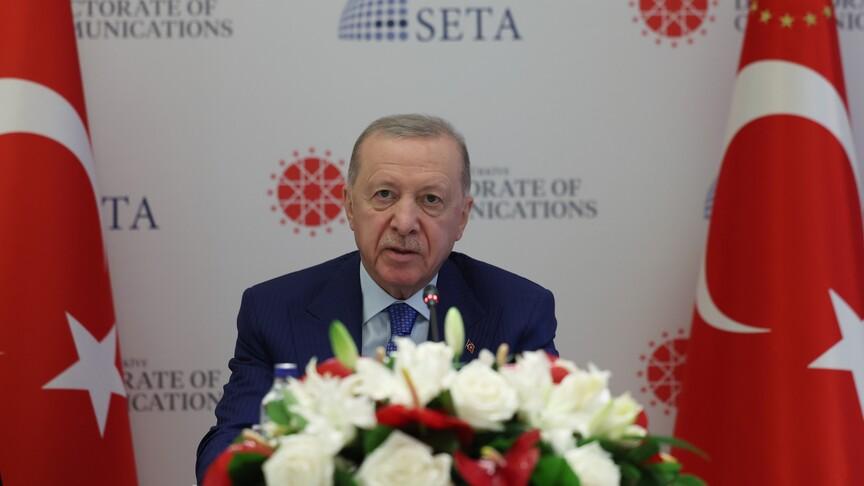
Turkish President Recep Tayyip Erdogan concluded his four-day visit to the United States on Wednesday, where he met with leaders of numerous countries in New York during his participation in the 86th session of the United Nations General Assembly. President Erdogan and his wife were welcomed at John F. Kennedy International Airport by Turkey's permanent representatives to both the UN and the US, as well as the Turkish Consul General in New York.
During his visit, Erdogan met with his Vietnamese counterpart To Lam, Libyan leader Mohamed al-Menfi, Kuwaiti Emir Sabah Al-Ahmad, and the former prime ministers of Kosovo, Lebanon, Georgia, Qatar, the United Kingdom, Japan, Poland, Bangladesh, and Senegal. In multiple meetings, Erdogan emphasized the importance of strengthening bilateral relations in the fields of investment, trade, defense industry, nuclear energy, and liquefied natural gas (LNG).
He also delivered a speech before the General Assembly, calling on all countries that have not recognized the State of Palestine to reconsider their stance, describing Palestinian President Mahmoud Abbas' absence from the hall as a "shadow that pains consciences." He stressed that Gaza today is not merely a graveyard for the world's largest number of children but an inhumane prison, urging the international community to increase pressure on Israel to rebuild Gaza without delay.
In other bilateral meetings, Erdogan affirmed that relations between Turkey and the UK are strengthening across all fields, while calling for reforms to the UN Security Council, stating that "the world is too big for just five members." He also met with UN Secretary-General Antonio Guterres to discuss issues of global peace and security before concluding his term.
Erdogan noted that bilateral trade volume between Turkey and the US exceeded $38 billion in 2025, expecting it to reach $40 billion by the end of the current year. Reaffirming the depth of strategic partnership, he said cooperation in energy, advanced technology, and defense is essential whether bilaterally or within NATO.
Analysis & context
Analysis & Context
Analytically, this visit by Erdogan emerges as part of Turkey's strategy to enhance its role as an independent regional and global power seeking to balance relations between the West and the East. The visit serves as a golden opportunity to solidify strategic partnership with the United States, which is undergoing major geopolitical shifts, especially under President Donald Trump who is seeking to reshape international alliances.
In the broader context, Erdogan places significant emphasis on the Palestinian cause as a central element in his address at the UN General Assembly, using the international platform to highlight the suffering of the Palestinian people and the necessity of restructuring the Security Council. This focus reflects Turkey's orientation toward adopting a leadership role in humanitarian and sensitive political issues that concern the Arab and Islamic worlds.
Additionally, the economic data mentioned in the report indicates notable growth in bilateral trade volume exceeding $38 billion in 2025, reflecting increasing attention to economic aspects as a foundational pillar of bilateral relations. This economic growth supports the idea that strategic relations extend beyond political and defense cooperation to encompass energy, technology, and aerospace fields.
Finally, Erdogan's meetings with leaders of the Gulf Cooperation Council and US President Trump at UN headquarters signal the importance of regional and international coordination in addressing global crises such as the war in Gaza and conflicts in the Middle East and North Africa. These meetings underscore Turkey's role as a bridge for communication among various international and regional parties.