Sourced fact
The News
The spokesperson for Deutsche Welle announced that the German broadcaster strongly supports Georgians in their commitment to democracy amidst a notable deterioration of freedoms in the country. According to Deutsche Welle, media figure and activist Nino Robakidze feels unsafe as a nation and as a long-time independent journalist due to her activities with international civil society organizations, which have made her a target in her country.
In discussing the current situation, Robakidze stated that Georgian journalists face physical, digital, and psychological threats, along with financial and legal pressures exerted on their media institutions. Robakidze participated in an open discussion organized by Deutsche Welle titled "Democracy Under Pressure" regarding the conditions of cultural and media professionals in Georgia, which was held on Thursday at the James-Simon Hall in Berlin.
Jochen Rosenkranz, Director of Culture and Sports at Deutsche Welle, noted the difficulty in finding Georgians willing to participate in the discussion due to fears of consequences for themselves, their friends, and their families. Mariaka Lapori-Burk, a Georgian-born musician, director, and cultural activist, stated that everyone is afraid of intimidation but agreed to participate in the discussion alongside Robakidze and Yuri Rishito, Head of the Deutsche Welle Office in Riga.
Lapori-Burk continued by stating that the government has become more creative in inventing arbitrary justifications for imprisoning those with critical voices, noting that civil society organizations and human rights groups estimate the number of detainees or pre-trial prisoners to be between 90 and over 100 people.
Analysis & context
Analysis & Context
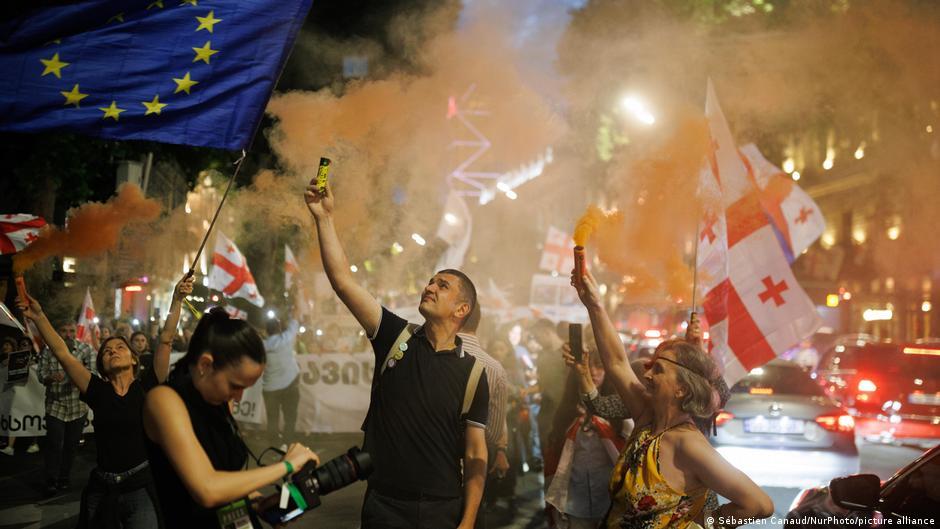
Analytically, Georgia was previously considered a leading democracy in the Caucasus region but is now undergoing a rapid transition toward authoritarianism under the "Georgia Dream" party, which has held power since 2012. The party has shifted from declaring itself pro-European to seeking more overt alignment with Russia, leading to the postponement of EU accession negotiations until 2028 despite a strong majority desire for European integration.
In the broader context, pressure on independent media and professional journalists has intensified following Russia's unjustified invasion of Ukraine, which launched an anti-Western campaign that significantly impacted Georgia's media environment. The country also witnessed anti-government protests in 2023 and 2024 driven by Europeans against new discriminatory laws resembling Russia's "foreign agent" legislation, which imposed strict restrictions on organizations receiving foreign funding.
These laws directly affect cultural institutions, artistic events, artistic organizations, heritage projects, and initiatives that heavily rely on funding from the European Union, European foundations, and international cultural programs. Additionally, Georgia's anti-LGBT law, titled "Law on Family Values and Protection of Minors," explicitly bans the "promotion" or "spread" of same-sex relationships and non-binary gender identities in public spaces, media, education, and arts.
Cultural producers are forced to take risks and choose between self-censorship and closing institutions entirely or facing severe state retaliation, as the anti-corruption agency overseeing the implementation of the "foreign agent" law uses it to hunt down prominent civil society groups through inspections and freezing their bank accounts.