Sourced fact
The News
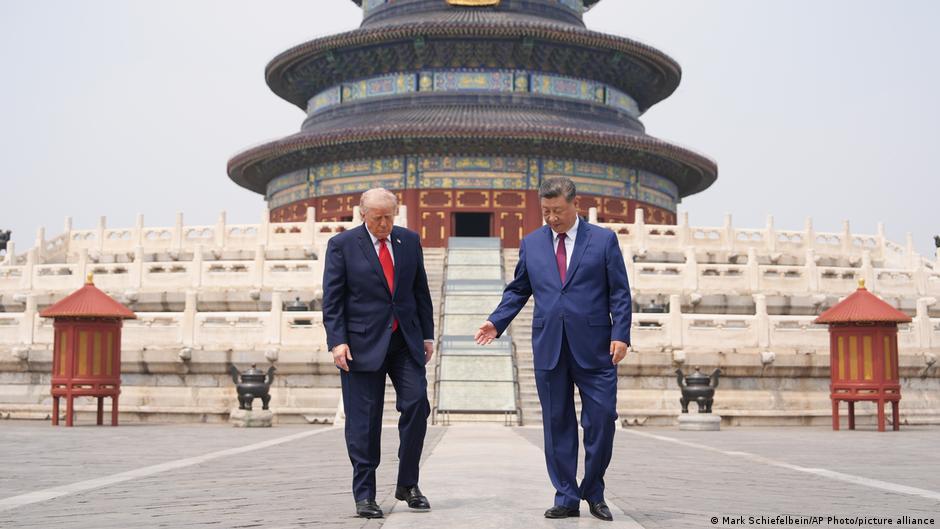
US and Chinese leaders meet in Washington this week to try to break the global trade deadlock, amid expectations that the meeting will bring some progress despite continued strategic competition between the two nations. Although President Donald Trump and President Xi Jinping are heading toward promising talks to ease the trade war launched by the US president, tangible results remain out of reach following the failure of the previous summit in Beijing last month.
Mikko Huotari, director of the China studies center "MERICS" in Berlin, describes the current situation as a state of strategic stalemate where Xi does not need an immediate breakthrough in Washington but needs more time, which also applies to the US administration. Trump indicated that both sides will discuss all issues during the Chinese president's visit to the White House, while experts believe that China and the United States will remain locked against each other in the foreseeable future.
Regarding artificial intelligence technology, the summit is expected to discuss new regulatory mechanisms after the US government approved a ban on exporting high-performance chips to China, while Beijing restricts the export of rare earth elements necessary for electronics production. US Treasury Secretary Scott Bessent confirmed that officials from both sides have already discussed establishing a reporting mechanism for security incidents related to artificial intelligence to enhance international cooperation in this sensitive field.
On another front, European Commission President Ursula von der Leyen warned of a "second China shock" hitting Europe now via Chinese technological progress in battery and green energy fields, leading to the removal of industry in the heartland industrial regions of the European Union. Brussels demands additional tariffs on cheap government-supported Chinese electric vehicles, while China denies any unfair advantage and calls on German companies like Volkswagen and BMW against imposing these tariffs out of fear of hostile Chinese reactions.
In an attempt to adapt to geopolitical changes, Canadian Prime Minister Mark Kani adopts a "changing engineering" strategy that allows medium-sized countries to work together instead of relying solely on the superpower. Kani visited China in early 2026 to sign a new strategic partnership reducing tariffs on Chinese electric vehicles to 6.1%, while planning to visit Shanghai in November to participate in the Asia-Pacific Economic Cooperation summit and avoid falling into the US threat list.
Analysis & context
Analysis & Context
From an analytical perspective, the current geopolitical landscape is characterized by increasing complexity as major powers attempt to rearrange their economic and security poles. The interaction between Trump and Shanghai shows that international relations are no longer fixed bilateral but have become dynamic depending on changing interests. This fluctuation places countries such as Canada and the European Union in a difficult position between choosing full engagement with one party or trying to maintain independence and sovereignty.
In a broader context, remarks by Canadian Prime Minister Mark Kani indicate a radical shift in the strategy of medium-sized countries that realize that relying on the dominance of one power exposes them to weakness. The idea of "changing engineering" proposed by Kani reflects a desire to shape flexible alliances that change according to issues and shared interests rather than adhering to rigid alliances that may harm their national interests.
Also, tensions within the Atlantic Alliance (NATO) and tensions between Canada and Canada with the United States highlight the fragility of traditional alliances under new US protectionist policies. Trump's threat to impose tariffs or stop trade with Europe if any action is considered "hostile" threatens to undermine the mutual trust built on decades of economic and security cooperation.
Finally, China's role as a major economic power goes beyond mere commercial competition to include challenging US dominance in areas such as artificial intelligence and energy. Beijing's ability to attract new allies through attractive diplomatic initiatives indicates a shift in global power balances where China seeks to expand its influence without entering direct conflicts with the United States.