Sourced fact
The News
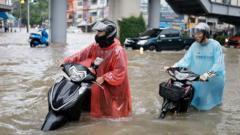
A state of emergency has been declared across all 50 districts of Bangkok following heavy rainfall exceeding 300mm since Thursday, which led to the submersion of numerous roads. Although local authorities reported Sunday that rainfall was decreasing, water levels in the canals remain extremely high according to the Integrated Metropolitan Administration of Bangkok.
The city governor has warned that flooding is not yet over, urging residents to stay indoors while advising those near canal networks to move their belongings to upper floors. Recent severe thunderstorms have overwhelmed the city's sewage system, causing traffic chaos on already congested roads.
Shadi Steeponut, the city governor, stated that eastern Bangkok was most affected as rain continued, explaining that canals filled with water and areas at risk are those near them. He added that despite efforts to pump out water, the flood threat remains high, especially in low-lying areas.
A 67-year-old resident living near North Bangkok Canal described the situation as extremely difficult, noting that water rose to his waist level, preventing exit and forcing him to close his shop for two days. He indicated that water levels appear worse than in 2011 when floods hit the entire country, resulting in hundreds of deaths.
The Thai Meteorological Department stated it expects heavy rainfall to continue next week as a low-pressure area causing rain moves toward central Thailand. No casualties have been reported in Bangkok so far despite unprecedented weather phenomena in recent days.
Analysis & context
Analysis & Context
Analytically, Bangkok ranks among the most flood-vulnerable cities in modern history, particularly with increasing frequency of extreme weather events due to climate change. The city's infrastructure, which heavily relies on a canal network, is no longer capable of absorbing the massive water volumes caused by recent storms.
In the broader context, reports indicate that flooding in Thailand is not merely a seasonal occurrence but an indicator of the city's deteriorating ecosystem, which depends on a delicate balance between canals and roads. Rapid urban expansion has contributed to reducing green spaces that previously acted as natural sponges for absorbing rainwater.
The role of modern technology in disaster management also emerges prominently, where authorities use advanced monitoring systems to track water levels and guide residents to safe areas. However, the speed of government response remains the critical factor in minimizing human and material losses in such emergency situations.
Finally, the current crisis highlights the importance of regional and international cooperation in facing natural disasters, as neighboring countries can provide logistical support and technical expertise to help Thailand recover more quickly from comprehensive flood impacts.