Sourced fact
The News
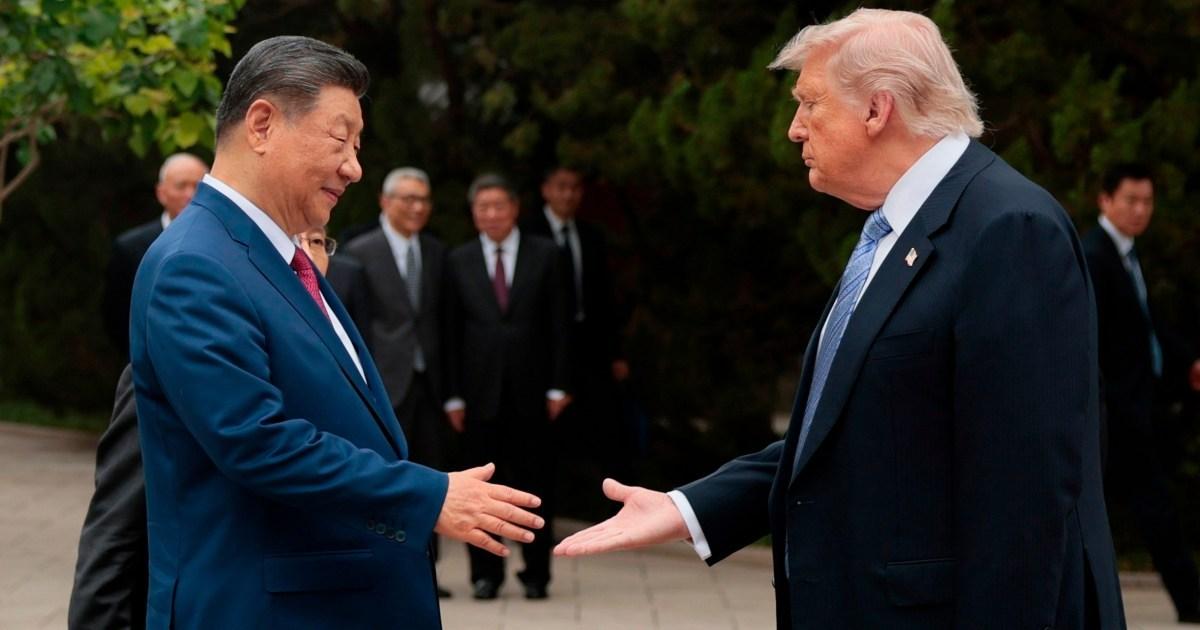
International efforts to slow down the development of artificial intelligence are facing major challenges amidst ongoing strategic competition between the United States and China, both of which have so far rejected calls from industry and researchers to slow the pace of development out of fear of existential risks for humanity. These tensions come at a time when U.S. President Donald Trump and Chinese President Xi Jinping are preparing for their third meeting this year in Washington, D.C., where expectations for cooperation on AI safety appear very modest compared to what experts say is needed to avoid potential catastrophes.
Alvin Wang Grahlen, a senior fellow at the Asia Institute of the American Policy Institute, said that the two countries host almost all edge labs and most loaded models, describing the agreed-upon controls between Washington and Beijing as "almost a prerequisite" for AI safety. Wang Grahlen added that a safety system covering only one-sided models solves half the problem, pointing out that mutual distrust and differing perceptions of key risks hinder effective cooperation opportunities between the two nations.
On his part, President Trump dismissed AI concerns as "conspiracy alliances," emphasizing the need to maintain U.S. superiority in this technology against China. Meanwhile, Chinese Security Minister Chen Yixin highlighted last month threats from adversarial powers that might use AI to spread political rumors and stir anti-emotional sentiments, warning of their danger to political, institutional, and intellectual security.
Shen Chen Hao, a fellow at Tsinghua University's International Security and Strategy Center in Beijing, explained that China recognizes risks of losing control and cyber threats but is highly sensitive to the consideration of "AI safety" as an excuse to restrict its access to chips, computers, and markets. Shen pointed out that the deepest obstacle is the ability of both parties to separate genuine cooperation in safety from broader technological competition, clarifying that Beijing would doubt the purpose of any cooperation if every security discussion were tied to export controls or slowing China's development.
In contrast, Dario Amodei, CEO of Anthropic, and Sam Altman, CEO of OpenAI, have called for slowing development and increasing regulation, while some experts argue for halting development immediately and imposing an unlimited international ban on advanced AI development. Otto Parton, the existential risk monitor at the Netherlands, warned that the model could reach a stage of recursive self-improvement without human supervision, raising doubts about where the positive feedback loop of these intelligent agents will end.
Analysis & context
Analysis & Context
Analytically, the core of the issue lies in the lack of consensus within the AI sector on how to regulate this technology or even whether government oversight is needed at all. While leaders like Dario Amodei and Sam Altman call for slowing the pace of development and greater regulation, others argue these calls do not go far enough and demand an immediate halt to development and an unlimited international deadline.
In the broader context, the roots of concerns between the two countries differ fundamentally; the U.S. debate focuses on the possibility of powerful AI escaping human control and causing catastrophic risks for humanity, while China's security concerns focus on geopolitical aspects such as the ability of the United States to gain a decisive advantage and use it against China.
Experts also point out that the greatest obstacle to cooperation is separating genuine safety collaboration from broader technological competition, where Beijing might doubt any cooperation if it is linked to industry withdrawals or slowing its development. Otto Parton, director of the Center for Existential Risk Monitoring in the Netherlands, emphasized that AI should not become strong enough to improve itself recursively without human supervision, because we do not know where the positive feedback loop of smarter intelligences will end.
Finally, some experts believe that dialogue between Washington and Beijing should focus on mitigating existing risks rather than stopping development entirely, especially since AI is already extremely useful and has the potential to provide transformative benefits to society if managed wisely through true international cooperation.