Sourced fact
The News
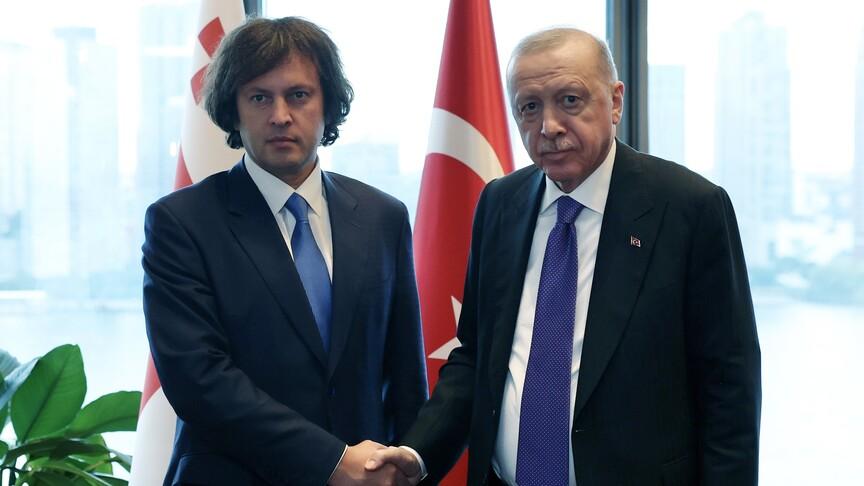
Turkish President Recep Tayyip Erdogan welcomed Georgian Prime Minister Irakli Kobakhidze in New York on Monday to discuss ways to strengthen bilateral ties and regional issues within the framework of UN General Assembly activities. This closed-door session took place inside "Turkish House" or Turkiye Center, where both parties focused on global and regional developments of mutual interest.
Erdogan expressed his deep satisfaction that Turkey remains Georgia's largest trading partner for 18 consecutive years, affirming that Ankara will continue to take practical steps to boost cooperation between the two countries, particularly in trade, transport, and security sectors. He also emphasized the importance of maintaining solidarity between Turkey and Georgia in various international forums to safeguard both nations' interests.
Erdogan highlighted the significance of maximizing cooperation mechanisms involving Turkey, Georgia, and Azerbaijan, noting that activating these mechanisms will have a positive impact on all three countries. This visit comes within the context of strategic relations linking the two nations, as Turkey recognized Georgia's independence in 1991 and signed a protocol establishing diplomatic relations between them in 1992.
Analysis & context
Analysis & Context
From an analytical perspective, this summit between Erdogan and Kobakhidze underscores the importance of strengthening the strategic geographical axis connecting South Caucasus with the Mediterranean Sea, where Georgia serves as a vital land and maritime bridge for Turkey toward the Middle East and Central Asia. The focus on transport and trade reflects Ankara's desire to diversify supply routes and enhance energy and food security through multi-regional partnerships.
In a broader context, the reference to cooperation with Azerbaijan highlights the significance of the Turkish-Azerbaijani-Georgian geographical triangle aimed at achieving regional stability and economic integration in a geopolitically sensitive area. This approach aligns with Turkey's foreign policy seeking to build flexible alliances based on shared interests rather than party affiliations or narrow ideological ties.
Moreover, the reference to diplomatic relations spanning over three decades confirms the nature of the established strategic partnership between the two countries, which goes beyond mere trade exchange to include important security and political dimensions amidst growing regional challenges. Continuation of this cooperative path enhances Turkey's standing as a influential regional power with direct impact on Caucasus region stability.