Sourced fact
The News
Chinese swimmer Yu Ziyue achieved a historic milestone by setting a new record at the Asian Games in the individual 400-meter freestyle event, completing her treble of individual gold medals two years before the Los Angeles Olympics. According to Al Jazeera Net, Yu concluded her run at this edition of the Games with a dominant victory in the race, achieving a new record time of 4 minutes and 28.56 seconds.
With this win, Yu became the first swimmer to complete her treble of individual gold medals at the Asian Games held in Tokyo, having previously won the 200-meter butterfly and 200-meter freestyle events also with record times. She surpassed the previous record set by her Chinese teammate Yi Xiong in 2014 by nearly 4.5 seconds, thereby taking fourth place globally this year behind the top three world record holders.
This achievement serves as strong evidence of Yu's readiness to be a major contender at the upcoming 2028 Olympics, especially after becoming the youngest medalist at last year's World Swimming Championships with her bronze medal win for the Chinese team. In March of last year, she further solidified her reputation as a global star by winning the 200-meter butterfly race against American swimmer Regan Smith, who holds seven Olympic medals.
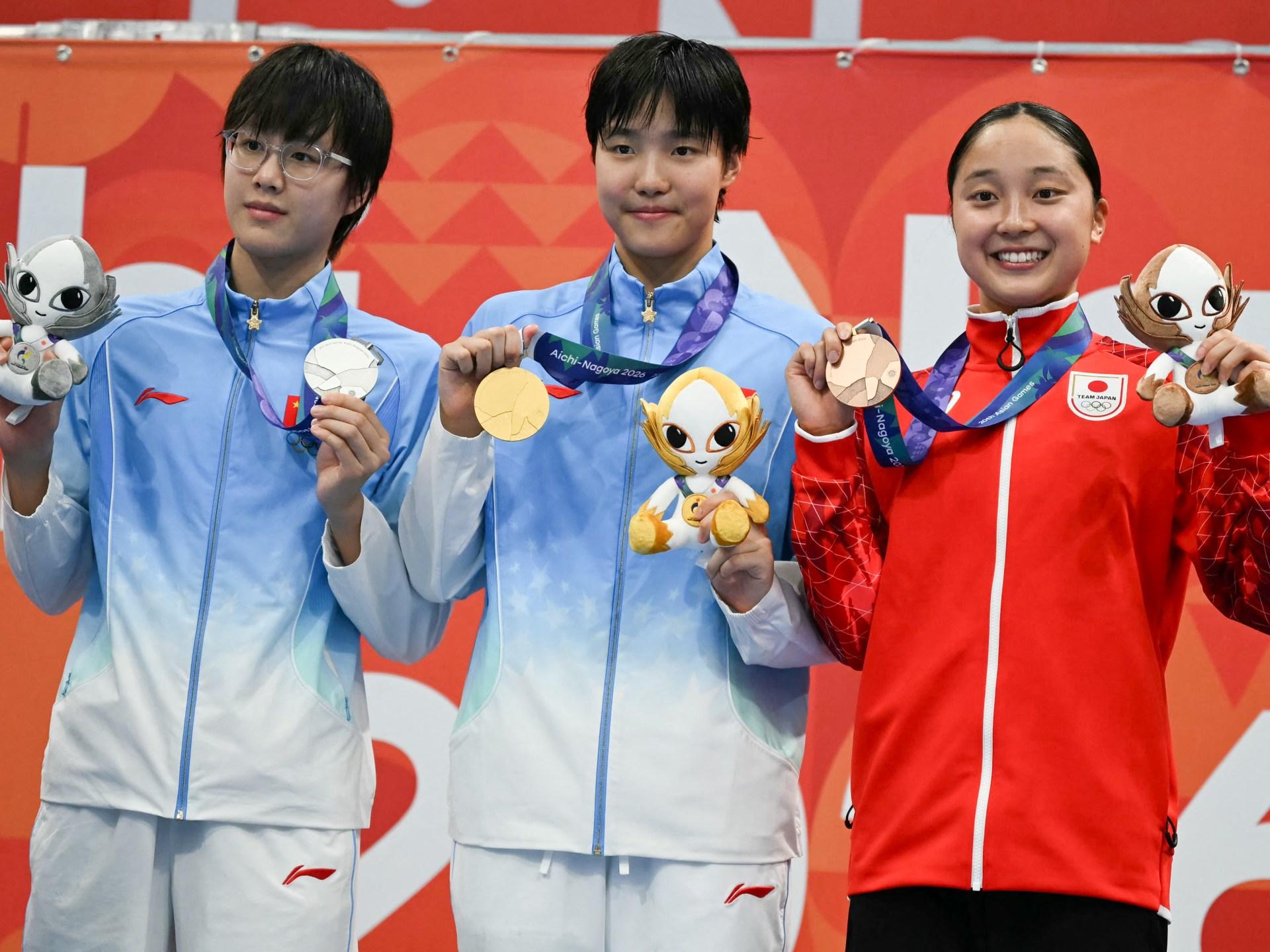
During the Asian Games, Yu demonstrated her dominance in the swimming pool, taking the initiative from the start to pull away from silver medalist Chinese teammate Qiu Wonsi by a margin of 3.95 seconds, while Japanese swimmer Mio Narita took third place. Yu's story became a source of local inspiration after she was discovered by a coach at an aquatic park and found the media interviews to be the hardest part of the competition.
Analysis & context
Analysis & Context
From an analytical perspective, Yu's rise represents a rare example of young talent developing at an exceptional pace in the competitive swimming world, successfully converting her accidental discovery into tangible global achievements within a short period. This model demonstrates how appropriate training environments and national resources can support emerging talents to become global contenders before reaching full sporting maturity.
In the broader context, the Asian Games emerge as a critical platform for developing swimming in Asia, where countries such as China, Japan, and South Korea compete intensively to prove their regional and global superiority. Yu's achievements are part of a new wave of Asian talents that has begun to emerge strongly in recent years, reshaping the competitive landscape of global swimming.
Additionally, focusing on young swimmers like Yu indicates a strategic shift in how sports talents are discovered and developed in many Asian countries, where talent searches now extend to non-traditional venues like aquatic parks rather than relying solely on major clubs. This shift contributes to diversifying the talent pool and increasing opportunities for new stars to emerge on the international stage.
Finally, global interest in Yu's story goes beyond pure sportsmanship to include humanistic and social dimensions, as her narrative has become an inspiration for youth worldwide, particularly regarding overcoming psychological challenges such as fear of media interviews and focusing on the joy of sport.