Sourced fact
The News
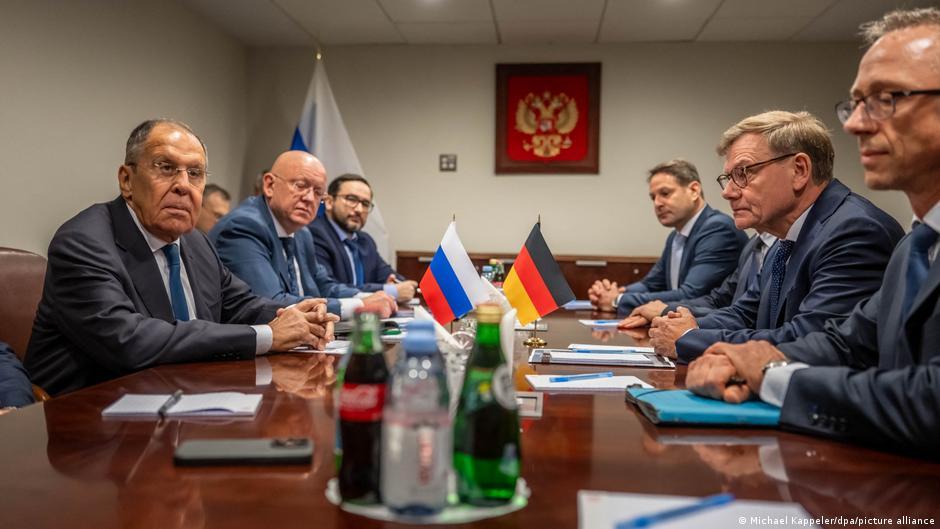
Concluding the plenary sessions of the 79th session of the United Nations General Assembly, the political landscape was marked by deep tensions between Germany and Russia and an international affirmation of the need to regulate artificial intelligence. German Foreign Minister Johann Wadefol met with his Russian counterpart Sergei Lavrov during a rare side meeting since the invasion of Ukraine in 2022, revealing unbridgeable divisions between the two countries over the battlefield in Ukraine.
Wadefol clarified that the meeting was difficult and highlighted the huge gaps between both parties, noting that he offered to calm the situation, especially in Ukraine, but without a firm Russian response. The German minister criticized Russia's escalating course after Moscow was accused of organizing a drone attack on Leipzig airport, confirming that Germany would not accept any incidents of this kind and would defend itself strongly.
On his part, Lavrov described the meeting as unnecessary and stated he heard no difference between Berlin's position and its previously announced official stance. He also pointed out that Germany is trying with everything it has to hinder talks aimed at ending the conflict between Moscow and Kyiv without achieving concrete progress on the ground.
In his speech before the General Assembly, Wadefol warned of the major risks that artificial intelligence poses to the global economy and infrastructure if control over it is left in the hands of a few countries and companies. He called for fundamental reforms at the United Nations to keep up with new challenges in a world where nationalism is increasing and the role of international institutions is weakening.
The German Foreign Minister also condemned the Russian war targeting the lives of millions of peaceful civilians, threatening European security and causing serious food crises affecting Africa, Asia, and the Middle East. He affirmed that Germany's support for Ukraine aligns with United Nations values and that the vast majority of General Assembly members continuously condemn Russian aggression.
In parallel developments, the foreign ministers of India and Saudi Arabia called for de-escalating tensions in the Middle East region and restoring freedom of maritime navigation in the Strait of Hormuz and the Red Sea. Meanwhile, Chinese Vice President Han Cheng emphasized the necessity for major countries to abide by international rules and avoid unilateral military actions that threaten global stability.
Analysis & context
Analysis & Context
From an analytical perspective, this meeting stands as a symbol of current diplomatic failure in resolving major conflicts, where bilateral talks have turned into mere exchanges of official letters without any real intent to reach an agreement. Germany's straightforward position reflects its full support for Ukraine and its demand for compliance with the UN Charter, which contrasts with Moscow's view that the West is practicing unfair sanctions.
In the broader context, Wadefol's remarks on regulating artificial intelligence focus on the new geopolitical shift imposed by modern technologies, where control over these technologies has become a source of global power. The German minister's emphasis on the need for international rules for AI reflects growing concerns about the technology's impact on the global economy and national security of states.
Furthermore, Wadefol's calls for UN reform come amid the declining effectiveness of international institutions in the face of regional conflicts, placing the United Nations organization in a precarious position between the need for reform and maintaining its sovereignty as a platform for international dialogue. The continued tensions around the Arabian Sea and the Strait of Hormuz add another layer of complexity to the current global geopolitical landscape.