Sourced fact
The News
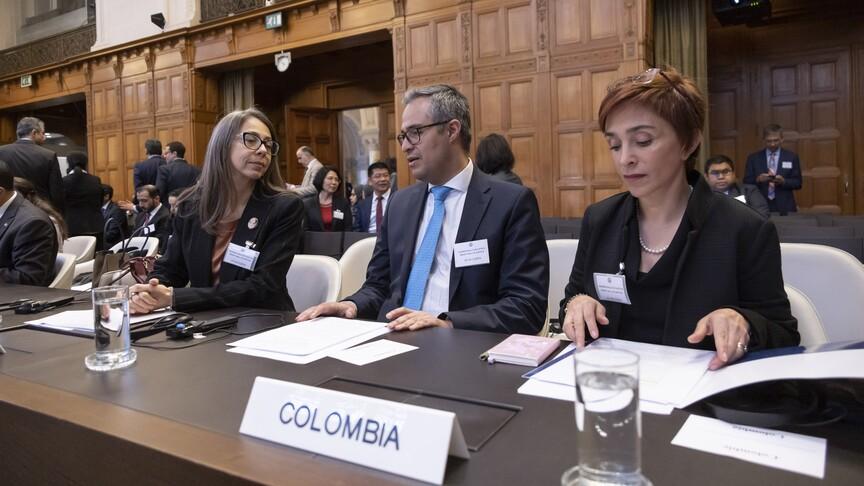
Colombia has officially announced its withdrawal from supporting South Africa's case against Israel before the International Court of Justice (ICJ), following a formal notification to the court regarding the retraction of intervention submitted on April 5, 2024. This announcement was made on September 22, 2026, when Colombia formally notified the ICJ of its decision to withdraw the intervention filed under Article 63 of the ICJ Statute, which allows states party to the convention to intervene in cases concerning its interpretation without becoming primary parties to the lawsuit.
This decision marks a fundamental shift reflecting a change in Colombian foreign policy adopted by new President Alvaro Uribe following his assumption of office last August, where the new government expressed its desire to restore diplomatic and economic relations with Israel. This reversal overturned the policies of former President Gustavo Petro, who strongly supported Palestinians during the war in Gaza; in May 2024, he announced plans to sever diplomatic ties with Israel and open an embassy in Ramallah.
In light of these political shifts, the new Colombian government has taken practical steps to strengthen ties with Israel, including reopening the Israeli embassy in Jerusalem and establishing a bilateral economic committee, alongside announcing a Colombian delegation's visit to Israel in October. The previous administration had halted exports of Colombian coal to Israel, considering it used for manufacturing weapons against Palestinians, but the new administration reversed this measure to serve shared economic interests.
The case before the ICJ in The Hague remains pending since December 2023 when South Africa filed the lawsuit accusing Israel of violating its obligations under the Convention on the Prevention and Punishment of the Crime of Genocide against Palestinians in Gaza, while Israel has strongly denied these allegations and rejected the provisional measures issued by the court. Despite several interim measures issued since January 2024, the core legal dispute remains ongoing with the withdrawal of international support previously provided by Colombia.
Analysis & context
Analysis & Context
From an analytical perspective, Colombia's withdrawal represents a strategic move reflecting changes in regional and global geopolitical equations, where states tend to reassess their positions based on evolving economic and political interests rather than adhering to long-term fixed stances. This shift highlights how changes in political leadership can lead to immediate repercussions in foreign policy even in sensitive international issues such as armed conflicts.
In a broader context, this step indicates that the Palestinian-Israeli issue remains a focal point of significant international attention, yet countries' positions swing between support and opposition depending on each nation's internal and external conditions. Colombia's situation demonstrates how economic and political pressures can influence stances on international issues even if a state had previously adopted a strong position.
It also underscores the role of the International Court of Justice as a primary judicial body of the United Nations in handling international disputes, where pending cases remain important despite changes in the positions of states parties involved. This case illustrates how international judicial decisions may be influenced by shifts in foreign policy of states providing support or intervening in cases.
Finally, this shift is part of a wider global trend reevaluating national priorities versus international commitments, where states seek to achieve their economic and political interests while maintaining their international reputation simultaneously.