Sourced fact
The News
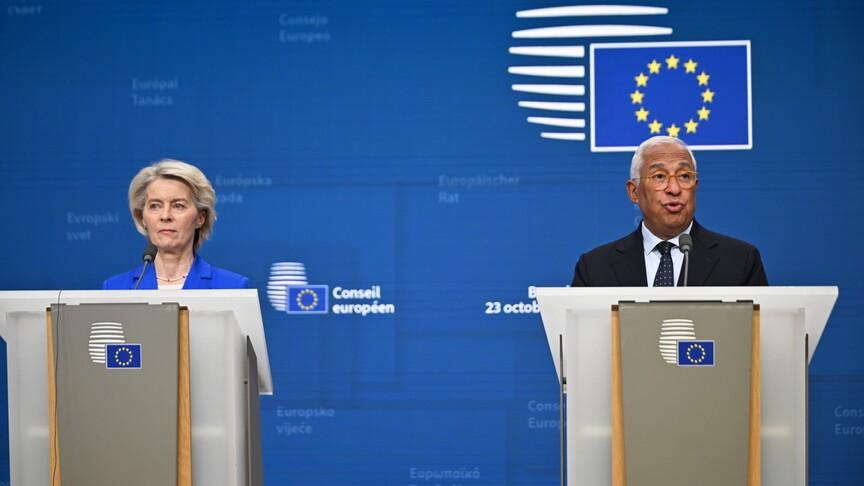
European Union leaders expressed clear support for the diplomatic role played by Islamabad in mediating between the United States and Iran during their meeting with Pakistani Prime Minister Shehbaz Sharif in New York. According to Anadolu Agency, European Commission President António Costa and European Council President Ursula von der Leyen commended the Pakistani Prime Minister's initiative to calm tensions and neutralize the military conflict that has erupted between the two countries.
This important meeting took place on the sidelines of the 81st session of the United Nations General Assembly, where both sides reviewed developments in the region and the world and reiterated the importance of dialogue, international diplomacy, and resolving disputes peacefully in accordance with international law. A statement issued by the office of the Pakistani Prime Minister clarified that the two sides discussed various regional and global issues, focusing on the necessity of ending differences through peace rather than military escalation.
European leaders also praised Islamabad's pivotal role in supporting de-escalation since the start of the US-Israeli military campaign against Iran in February of this year. The statement noted that Pakistan plays a vital role in enhancing dialogue and resolving conflicts peacefully, reflecting its commitment to global peace and regional stability amidst ongoing tensions between Russia and Ukraine and the renewed US-Iranian conflict.
The European leadership emphasized the value of its strategic partnership with Pakistan, noting that the Strategic Engagement Plan reflects the breadth of this partnership and the shared commitment to democracy, the rule of law, and human rights. At the conclusion of the meeting, EU leaders expressed their gratitude to the Pakistani Prime Minister for his mediation initiative, affirming that continued cooperation aims to enhance security and stability in the region and the world at large.
Analysis & context
Analysis & Context
From an analytical perspective, this meeting represents a confirmation of Pakistan's geopolitical shift from a merely medium-sized state to a major diplomatic player capable of influencing major files such as the US-Iranian conflict. Islamabad's ability to host sensitive dialogues between warring parties reflects its unique strategic position, combining proximity to Iran with close ties to the United States through the South Asia Alliance.
In a broader context, these diplomatic efforts come at a critical time when military tensions between the United States and Iran have escalated since last February, making any attempt at international mediation an urgent necessity to prevent the expansion of regional war. The European Union's support for this Pakistani mediation indicates a clear European desire to avoid a scenario of full-scale war that could lead to major economic and security disruptions affecting Europe itself through interruptions in energy supplies and raw materials.
Furthermore, the emphasis on "international law" and "peaceful resolution of disputes" in the EU statement highlights an attempt by Western leaders to reframe the conflict within legal and diplomatic frameworks rather than allowing it to evolve solely according to military logic. This approach also reflects a European response to the growing role of Global South countries like Pakistan in shaping political solutions, which may change traditional negotiation dynamics that have been exclusively dominated by major powers.
Finally, the continuation of the strategic partnership between the European Union and Pakistan despite global challenges indicates that the bilateral relationship goes beyond narrow economic interests to include deep security and political dimensions. The Strategic Engagement Plan mentioned in the statement is not merely an administrative document but a framework aimed at solidifying democracy and human rights as fundamental pillars of the relationship, thereby granting the Pakistani diplomatic dimension broader and deeper international legitimacy in the eyes of the global community.