Sourced fact
The News
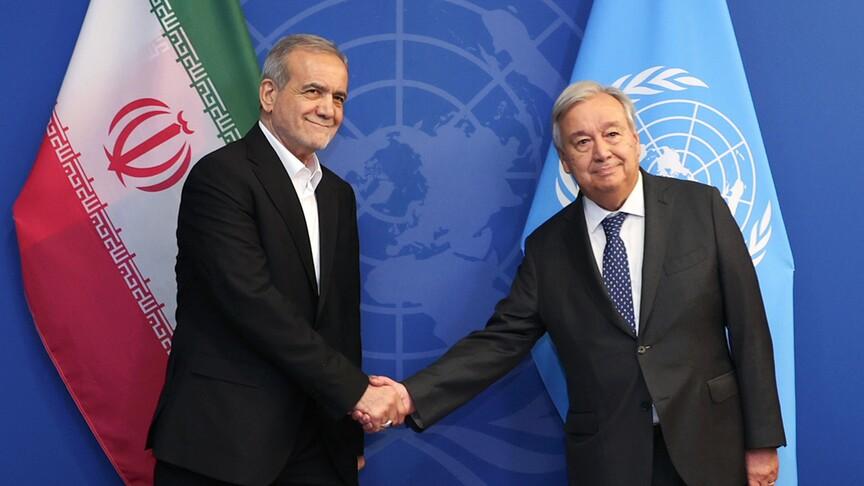
UN Secretary-General Antonio Guterres met with Iranian President Masoud Pezeshkian in Washington on Friday to explore ways to resolve the conflict in the Middle East through dialogue and negotiations. Anadolu Agency confirmed that during the meeting, Guterres emphasized the urgent need to resolve the conflict while fully respecting international law, including rights of navigation and freedom in the Strait of Hormuz and its surrounding areas.
According to a UN statement, the Secretary-General expressed the organization's commitment to supporting all diplomatic efforts aimed at achieving stability in the region. This meeting comes as Iran announced a seven-day plan to end hostilities and reopen the strategically vital maritime passage.
Iranian Foreign Minister Abbas Araghchi told reporters that the proposed plan reached Washington via Qatar, noting that the strait would open within a week if necessary conditions are met. However, the United States has not yet officially responded to this proposal as of now.
This diplomatic engagement follows the war launched by the United States and Israel against Iran on February 28 last month, which Tehran stated resulted in the deaths of thousands of civilians. Iran retaliated with missile and drone strikes in the region, effectively closing the Strait of Hormuz, a vital artery for global energy supplies.
Analysis & context
Analysis & Context
From an analytical perspective, this meeting represents a potential turning point in the trajectory of the regional crisis, as the international community, through the UN, attempts to break diplomatic stalemate following a period of intense military escalation. The significance of the Strait of Hormuz extends beyond being a vital shipping route for global oil; it is also a sensitive area where the national security interests of major powers intersect with Iranian sovereignty.
In the broader context, Iran's proposal of a specific timeline to reopen the strait reflects a desire to demonstrate diplomatic flexibility after suffering significant human and material losses. Furthermore, reliance on Qatar as a primary communication channel indicates the growing role of Gulf mediation in managing complex Middle East crises.
The greatest challenge remains ensuring the implementation of any potential agreement, especially with ongoing tensions between the United States, Iran, and Israel. The outcomes of this meeting could be decisive in determining whether the region will enter a new phase of relative calm or continue its military and economic escalation.