Sourced fact
The News
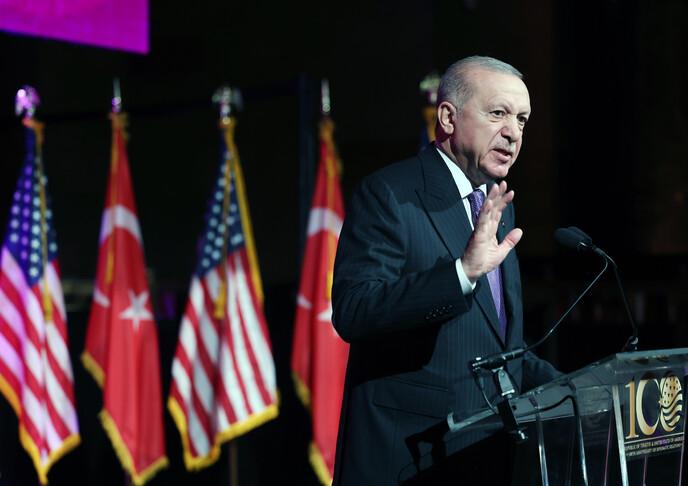
Turkish President Recep Tayyip Erdogan announced on Wednesday that strategic cooperation between Ankara and Washington is expanding across all fields, as Turkey seeks to transform political alignment into stronger economic ties. Speaking at a meeting of the Turkish-American Business Council held in New York, Erdogan stated that the two countries have recently reached major agreements in energy, aviation, and other vital sectors.
The President clarified that the United States has now become Turkey's largest supplier of liquefied natural gas, noting that Turkey intends to expand this cooperation to cover the entire energy sector, including nuclear energy. He also emphasized that economic relations should not be assessed solely through trade figures but require a model for strategic economic cooperation given the reshaping of the global economic system.
In response to questions about Turkey's economic program and its progress toward its goals, he stated that the program rests on four main pillars: price stability, fiscal discipline, sustainable external balance, and structural transformation. He noted that Turkey has made tangible progress in these areas despite regional wars, with core inflation dropping to low levels since 2020 while rental inflation reached its lowest point in four years.
Erdogan predicted that inflation would end the current year at around 28% instead of the late twenties if war impacts did not occur, confirming that 2027 would be stronger regarding the collapse of inflation. He also explained that Turkey maintains a strong position in fiscal discipline, having achieved a better budget than targeted despite tax cuts to protect citizens and the real sector from rising fuel prices.
He added that the expected budget deficit at year-end stands at 3.1% of GDP compared to an average approaching 6% in comparable countries, while public debt remains below 22% of GDP versus an average of 78% in developing nations. He further noted that Turkey has maintained a current account deficit and external debt indicators below their 20-year averages despite rising energy prices.
Erdogan stated that productivity is the central issue, which led to placing structural transformation at the heart of the economic program, accelerating infrastructure investments that enhance capabilities in artificial intelligence and digital transformation. He also highlighted the importance of defense and advanced technologies, pointing out that the Turkish military industry based on NATO standards has reached the ability to contribute to the security of their allies' supply chains.
Analysis & context
Analysis & Context
From an analytical perspective, this announcement represents a strategic shift in Turkish foreign and economic policy as it seeks to cement its position as an economic bridge between Europe and Asia. The emphasis on cooperation with the United States comes amid the redrawing of global geopolitical maps, where supply chains are shifting to prioritize reliability alongside low cost.
In a broader context, the focus on infrastructure projects such as the Baku-Tbilisi-Ceyhan pipeline and the East Mediterranean Corridor highlights Turkey's role as a vital link in the region. Furthermore, hosting the COP31 climate conference in Antalya reflects Turkey's ambition to lead green transformation and technological innovation on the international stage.
The economic data cited indicates relative success in curbing inflation and improving the overall budget, thereby enhancing Turkey's economy's resilience against external shocks. This development in the defense sector is considered a crucial step toward strengthening the country's strategic sovereignty and reducing reliance on sensitive external sources.