Sourced fact
The News
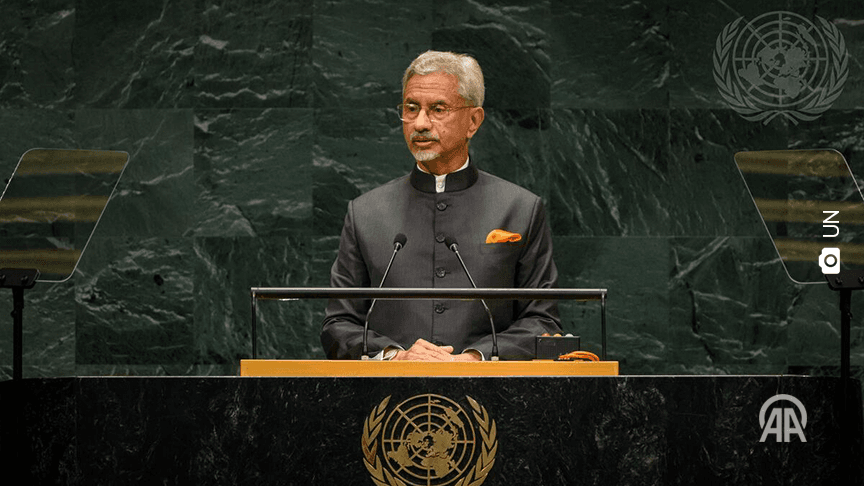
At the United Nations General Assembly meeting yesterday Saturday, India reaffirmed that a two-state solution is the only path to lasting peace in the Middle East amidst the ongoing Israeli war on Gaza. Indian Foreign Minister Subrahmanyam Jaishankar called upon the warring parties to exercise restraint and explicitly rejected targeting commercial ships and sailors in international waterways.
The minister clarified that tensions and violence continue in the region, noting India's contribution to humanitarian relief efforts for the Palestinian people. He also warned of new challenges in the maritime domain added to existing land-based issues, condemning attacks on commercial shipping and sailors in the Gulf, Red Sea, and Black Sea as entirely unacceptable.
Jaishankar stated that Indian sailors have lost their lives in these attacks, as have sailors from other countries, calling on the world to ensure the safety and security of maritime transport and crews. In another context, he expressed concern over the continuation of Russia's long war with Ukraine, which Prime Minister Narendra Modi described as a major disturbance requiring immediate cessation.
The minister also addressed the topic of artificial intelligence, viewing it as a transformative engine for human empowerment, economic prosperity, and solving problems on a population scale. He emphasized every nation's right to shape its own ecosystem by developing models and deployment strategies aligned with national goals and priorities.
He concluded by stating that the world is moving rapidly toward a multipolar world, and the international system established after 1945 must accommodate a new reality requiring inclusive civil dialogue that excludes no segment of humanity.
Analysis & context
Analysis & Context
From an analytical perspective, India's new stance at the United Nations represents a strategic shift reflecting New Delhi's desire to play a more active role as a neutral and trusted mediator in Middle Eastern files and major power dynamics. The reaffirmation of the "two-state solution" serves as a renewal of commitment to international principles supported by India for decades, linking this solution to the concept of comprehensive peace that extends to global maritime security.
In the broader context, Indian minister statements on artificial intelligence indicate India's clear vision for leveraging modern technology to serve economic development and solve global problems, particularly within its partnerships with Global South countries. This position also reflects India's recognition that the post-1945 international system is undergoing a difficult transition toward a multipolar world, necessitating broad civil dialogue that includes no part of humanity.
India's focus on protecting its maritime interests in international waters as part of its comprehensive security strategy stands out, especially with increasing attacks on commercial ships in regions like the Red Sea and Arabian Gulf. This concern goes beyond the economic dimension to include the humanitarian and ethical dimensions India adopts in its foreign relations.
Finally, India's call for reforming institutional multiplicity reflects its deep understanding that sustainable peace can only be achieved through renewed international institutions capable of addressing the complex challenges facing the world today, including humanitarian crises, food security, and energy security.