Sourced fact
The News
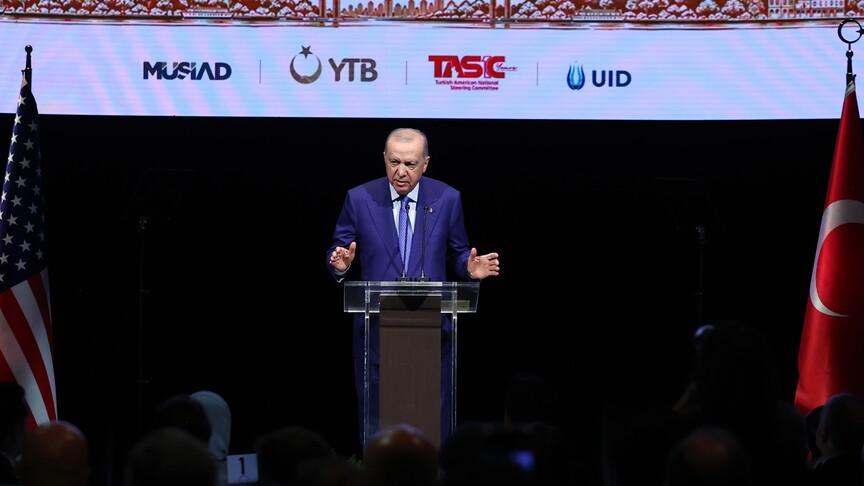
Turkish President Recep Tayyip Erdoğan called for the inclusion of Muslims within the societies in which they live without demanding that they give up their language, culture, or roots. He made this appeal during an event in New York on Wednesday. He explained that there are problems in many parts of the world, especially Europe, where Muslims are expected to integrate rather than assimilate, affirming his acceptance of integration and his rejection of all forms of assimilation.
Erdoğan pointed out that members of the Turkish community can enhance their standing in political, economic, social, and cultural life while maintaining their ties to their homeland. He considered learning the language and culture and preserving connections not as an obstacle to integration. He also urged Turkish leadership to increase the representation of Americans of Turkish origin in sectors such as politics, business, academia, and the arts to ensure that individual achievements continue as enduring institutional bodies across generations.
The President said that stronger communities can help combat anti-Muslim sentiments, racism, intolerance, and prejudice, calling on citizens to exercise their democratic rights in the upcoming United States elections to express their will at the highest levels. He also emphasized the necessity of continuing community activities in the United States with a spirit of unity, solidarity, and mutual brotherhood to strengthen ties between the two countries.
Erdoğan welcomed the work of the Turkish-American Steering Committee and other civil committees, confirming that Turkey would continue to support Turkish citizens and communities in the United States with all possible forms of support.
Analysis & context
Analysis & Context
From an analytical perspective, Erdoğan's stance represents a direct response to the spread of "cultural melting pot" phenomena in Western Europe, where migrants are expected to abandon their identities to fully adopt the majority culture. This position reflects a shift in Turkish political discourse toward supporting expatriates as cultural bridges connecting East and West, rather than becoming isolated or assimilated elements.
In a broader context, Erdoğan's statements indicate long-term strategies aimed at building strong institutional networks for expatriates beyond national borders, thereby enhancing the home state's influence abroad without imposing direct cultural dominance. This approach aligns with policies of many countries seeking to protect their citizens' rights abroad while ensuring their smooth integration into host societies.
Erdoğan's focus on American elections also highlights a broader strategy to support Turkish communities in advancing their national interests, reflecting a deep understanding of the role of civil society in shaping local and international policies. This continuous support from the home state serves as an effective tool to counter discrimination and anti-Muslim hatred spreading in some Western societies.