Sourced fact
The News
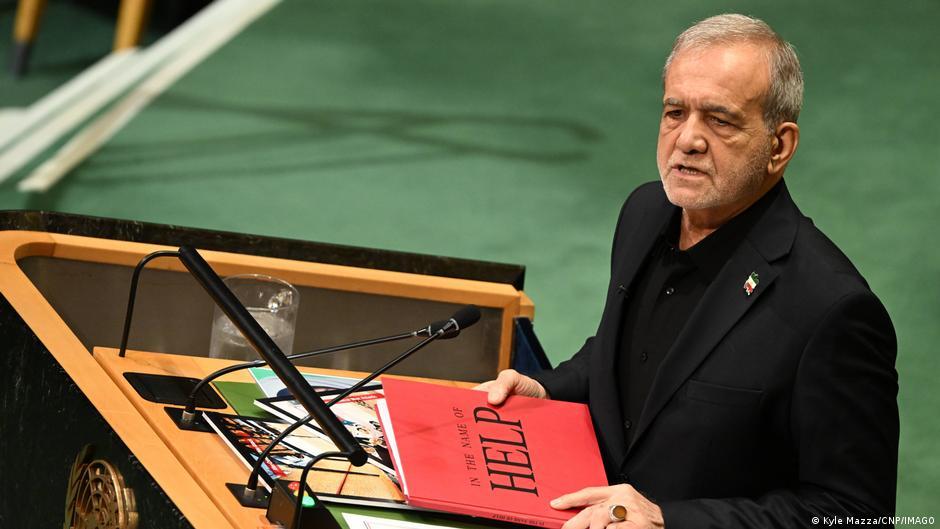
Iran is seeking to restore dialogue channels with the United States through President Masoud Pezeshkian's visit to New York for the UN General Assembly, where he sparked debate over the nuclear file and regional influence. In an exclusive interview with American Fox News network, Pezeshkian stated that his country is ready to comply with its international obligations under the Nuclear Non-Proliferation Treaty without compromising on its principle of completely rejecting the production of atomic bombs. The Iranian president also pointed out that the Supreme Leadership has issued a religious fatwa prohibiting the possession of weapons of mass destruction, while simultaneously confirming that the International Atomic Energy Agency estimated Iran's uranium stockpile enriched up to 60% at 440 kilograms since cooperation with it stopped after Israeli and American attacks in 2025.
The Strait of Hormuz is a key focus of new negotiations, where Iranian Foreign Minister Abbas Aragchi proposed reopening the vital maritime corridor within seven days if certain conditions are met, while the White House administration confirmed continued positive talks through unspecified intermediaries. Middle East expert Arman Mahmoodian confirms that Tehran still follows a dual strategy combining military and diplomatic pressure, seeking to exploit the strait to prevent the return of normal shipping traffic to its usual levels while working on rebuilding damaged military infrastructure within the country.
On his part, US Secretary of State Marco Rubio in New York clarified that while reaching an agreement with Iran is important, it requires a long time and difficult negotiations, affirming that President Donald Trump has military options available alongside the diplomatic track. Expert Kelly Greco also warned that the United States could get caught in a vicious cycle of attacks and reconstruction if a long-term strategy is not established, especially since Iran's mobile and distributed capabilities make targeting them extremely difficult. In the regional context, the Iran-backed Houthi movement expanded its control over the Yemeni Red Sea coast and the Bab el-Mandeb Strait, giving Tehran an additional lever in the global geopolitical equation.
Analysis & context
Analysis & Context
From an analytical perspective, the Iranian president's visit to New York may open direct communication channels between Tehran and Washington, although experts point out that the final decision still lies with hardline elements in the Islamic Revolutionary Guard Corps, which retain significant influence over the decision-making process.
In a broader context, reports indicate that Iran follows a dual strategy combining military and diplomatic pressure, continuing to rebuild its military infrastructure within the country while attempting to negotiate political agreements to alleviate ongoing sanctions and military threats.
The Strait of Hormuz and the Red Sea also represent critical points in regional geopolitics, where Iran seeks to use them as pressure tools to prevent the full return of normal shipping traffic, complicating US efforts to secure global trade routes despite damage to its navy and defense capabilities.
Finally, experts confirm that any final agreement with Iran will take a long time and require difficult negotiations, especially as the US administration emphasizes the availability of military options alongside the diplomatic track to achieve its strategic goals in the region.