Sourced fact
The News
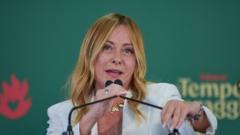
The Italian government has approved a ban on wearing the niqab and burqa in schools, while imposing a maximum cap of 30% for students who do not speak Italian in the first grades of primary and secondary education. Prime Minister Giorgia Meloni described these measures as logical tools that aid integration without causing division, insisting that no one should be allowed to make a decision that hides a young girl in the name of tradition.
The new package specifies the precise scope of application: the ban will apply only to burqas and niqabs that cover the face, while the hijab remains permitted as long as it does not cover the face. Regarding the percentage of non-Italian-speaking students, the criteria for defining them will vary by educational level; in primary schools, this includes non-citizens who were not born in Italy or have not attended kindergarten for at least two years.
In contrast, Education Minister Giuseppe Valditara clarified that this language limit is not based on nationality discrimination but is a purely linguistic measure, while framing the ban on niqabs and burqas as an issue of gender equality. He indicated that the goal of balancing students with weak language skills across nearby schools is to avoid creating isolated classes resembling ghettos or educational segregation.
The plan faced sharp criticism from opposition parties, who accused the government of bowing to the policies of the right-wing extremist "Fratelli d'Italia" party before the upcoming general elections, while Democratic Party leader Elly Schlein described the plan as mere propaganda that is difficult to implement. In response to these accusations, Valditara rejected the idea of persecuting anyone specific, stating that they are the ones pursuing him if there is anything, citing that the government seeks to apply the law rather than achieve personal interests.
Local school offices will be required to redistribute students to ensure they are not concentrated in certain schools, while providing free Italian language courses for parents facing language barriers that prevent their children's integration. This regulation is an executive decree that can be activated immediately but must be ratified by Parliament within 60 days, a step that goes beyond the 2010 Ministry of Education guidelines which set the percentage as a non-binding rule.
Analysis & context
Analysis & Context
From an analytical perspective, this decision represents a major shift in Italian education policy, which previously relied on ministerial guidelines rather than binding laws; the announced limit for non-citizen students is now turned into actual legislation that can be implemented immediately without needing parliamentary ratification within 60 days.
In the broader context, this measure reflects escalating political tensions in Italy around issues of identity and belonging, especially with general elections approaching and witnessing fierce competition between the ruling coalition and left-wing and extremist parties. It also highlights the growing influence of the right-wing hardline party seeking to impact public policies by supporting strict restrictions on religious symbols in public spaces and educational institutions.
Figures indicate that non-citizen students make up 11.6% of total school students in Italy, making the application of any relative limit such as 30% an administrative challenge requiring precise student distribution among different schools to ensure they are not concentrated in certain ones. Additionally, providing free Italian language courses and referring intractable cases to social services is part of the state's strategy to enhance integration rather than isolation.
Finally, the debate around this law remains open between its supporters, who see it as a step toward equality and integration, and its opponents, who view it as an attempt to appease a specific electoral base at the expense of students' rights and freedom of expression in the educational environment.