Sourced fact
The News
Early Sunday morning, Iran launched a missile and aerial attack on a US military base in Bahrain, marking the second assault targeting the Gulf nation within three consecutive days. The Iranian Revolutionary Guard Corps announced that its forces deployed six drones to target an American air defense radar facility at Rafha Air Base. Bahrain's Interior Ministry reported that its air defense systems successfully intercepted and destroyed the Iranian drones before they could reach their targets, while urging citizens to move to the nearest safe location upon hearing sirens.
Bahrain's Foreign Ministry stated that the kingdom condemns in the strongest terms Iran's continued savage attacks on its territory and holds Iran fully responsible for the consequences. On its part, the Iranian Revolutionary Guard Corps declared the Strait of Hormuz closed, warning that any US aggression would face a harsher and more powerful retaliation. US forces denied this claim, confirming that the two one-way drones launched by Iran were shot down immediately upon entering Bahraini airspace without causing casualties or material damage.
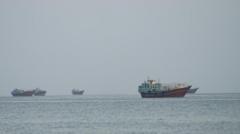
This escalation occurs amid an ongoing confrontation between the two nations over control of the Strait of Hormuz, through which flows one-fifth of global oil and gas supplies. The US imposed a naval blockade after Iran resumed its attacks on ships in February. Previous negotiations that led to a preliminary agreement to end the war and reopen the maritime corridor in June collapsed quickly after Iranian attacks resumed and Washington reimposed the naval blockade on Iranian ports.
In related developments, US news agencies reported that US forces carried out limited defensive strikes on Iran's Kish Island in recent days in response to the Revolutionary Guard firing at a US aircraft. Iran's official news agency confirmed explosions on the island, while the Revolutionary Guard did not comment directly but noted it had downed two American drones south of the island and another east of the strait. President Donald Trump's statement expressing Washington's disinterest in a war-ending deal with Iran, coupled with Vice President JD Vance's focus on US domestic affairs, has sparked concern over the region's future.
Analysis & context
Analysis & Context
From an analytical perspective, the escalation involving drone attacks and direct military responses represents a dangerous shift in the dynamics of the conflict between Iran and the United States, as the dispute moves from diplomacy to direct field operations in a geographically sensitive area. The continuation of these escalations reflects the failure of recent diplomatic efforts, which ended with the collapse of a preliminary agreement to end the war and reopen the strait just weeks after being reached.
In the broader context, the Strait of Hormuz remains a vital geopolitical axis that cannot be overlooked, as any disruption in the flow of oil and gas through it directly impacts global markets and energy supply security. Recent events indicate that both Iran and the US are moving toward a strategy of direct military deterrence rather than relying solely on diplomatic channels to resolve emerging disputes over maritime routes.
Reports also suggest that recent negotiations failed due to continued attacks on ships and the reimposition of the naval blockade on Iranian ports, complicating any chance of returning stability to the region. The new approach within the US administration, exemplified by Vice President Vance's focus on domestic affairs, may reduce opportunities for resuming peaceful talks with Iran in the near term.
Finally, regional and international reactions remain extremely cautious toward this escalation, as Gulf states strive to maintain their security and stability amidst a growing military storm that directly threatens their economic and security interests.