Sourced fact
The News
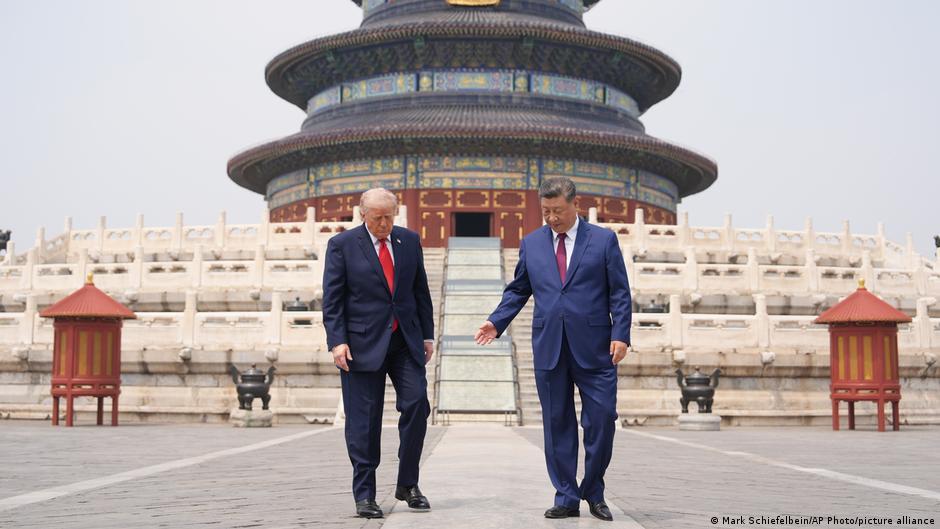
US and Chinese leaders are meeting in Washington this week to discuss ways to ease the escalating trade war between the two countries, while another economic dialogue currently taking place in Dusseldorf, Germany, focuses on trade and investment despite rising strategic tensions. Although President Donald Trump promised to discuss all issues with Chinese President Xi Jinping during his visit to the White House, experts point out that the current situation resembles a strategic stalemate where neither side needs a sudden breakthrough but rather more time.
Artificial intelligence is one of the most prominent areas of competition between Beijing and Washington, as the US imposes an export ban on high-performance chips for China while China restricts the export of rare earth elements necessary for producing semiconductors. In an attempt to allay concerns about lack of AI regulation, US and Chinese officials discussed creating a mechanism to report AI security incidents following a meeting in New York.
On another front, European Commission President Ursula von der Leyen described Europe's economic situation as suffering from a "second China shock" that has led to a reshaping of European industries and is driving industry out of the EU's core industrial regions. Berlin called for additional tariffs on cheap Chinese electric vehicles despite opposition from major German companies like Volkswagen and BMW, fearing loss of revenue due to China's harsh reactions.
While Trump pressures his EU allies to tighten technical and security restrictions against China, Canadian Prime Minister Mark Carney is adopting a policy of "flexible engineering" based on temporary alliances built on shared interests rather than engaging in two-way conflicts that place middle powers in weak positions. This was demonstrated by Canada reducing tariffs on Chinese electric vehicles from 100% to 6.1% and signing a new strategic partnership with Beijing at the beginning of 2026.
China is also seeking to strengthen its ties with wavering allies through participation in multiple summits such as the BRICS summit in India and the Shanghai Cooperation Organization summit, with expectations that Xi will visit the US again in December to participate in the G20 summit in Miami. Expert Mikko Huotari notes that Beijing is running a campaign of attraction toward American allies to enhance its strategic position amidst current geopolitical fluctuations.
Analysis & context
Analysis & Context
From an analytical perspective, the meeting between Trump and Xi represents a critical moment in managing the geopolitical and economic conflict currently dominating the global scene. Describing the situation as a "strategic stalemate" reflects a reality where great powers avoid direct escalation that could lead to full-scale economic wars but continue competing through trade and technical barriers that create ongoing uncertainty for medium-sized companies and countries.
In the broader context, the "second China shock" mentioned by European Commission President refers to a fundamental shift in the nature of global competition; it has moved from mere price-based competition on cheap products 25 years ago to advanced technological competition in green energy and electric vehicles. This transformation threatens to overturn traditional industrial power balances in Europe and places them on the defensive against China's rapid progress, which enhances its export and technical capabilities.
Prime Minister Mark Carney's approach reflects what could be called "flexible engineering" of diplomacy, where medium-sized countries liberate themselves from single dependence on great powers and build flexible alliances that change according to interests and crises. This approach aims to avoid falling into the trap of the "list" warned against by Carney, where small countries become mere tools for negotiation between major powers rather than active partners in the international system.
Finally, the issue of artificial intelligence emerges as a new field of strategic competition that may determine the future of global hegemony; the US seeks to maintain its leadership through export restrictions while China calls for international cooperation while maintaining its technological sovereignty. Any agreement in this area will have far-reaching effects on cyber security and the global digital economy, making it a central focus in upcoming Washington talks.