Sourced fact
The News
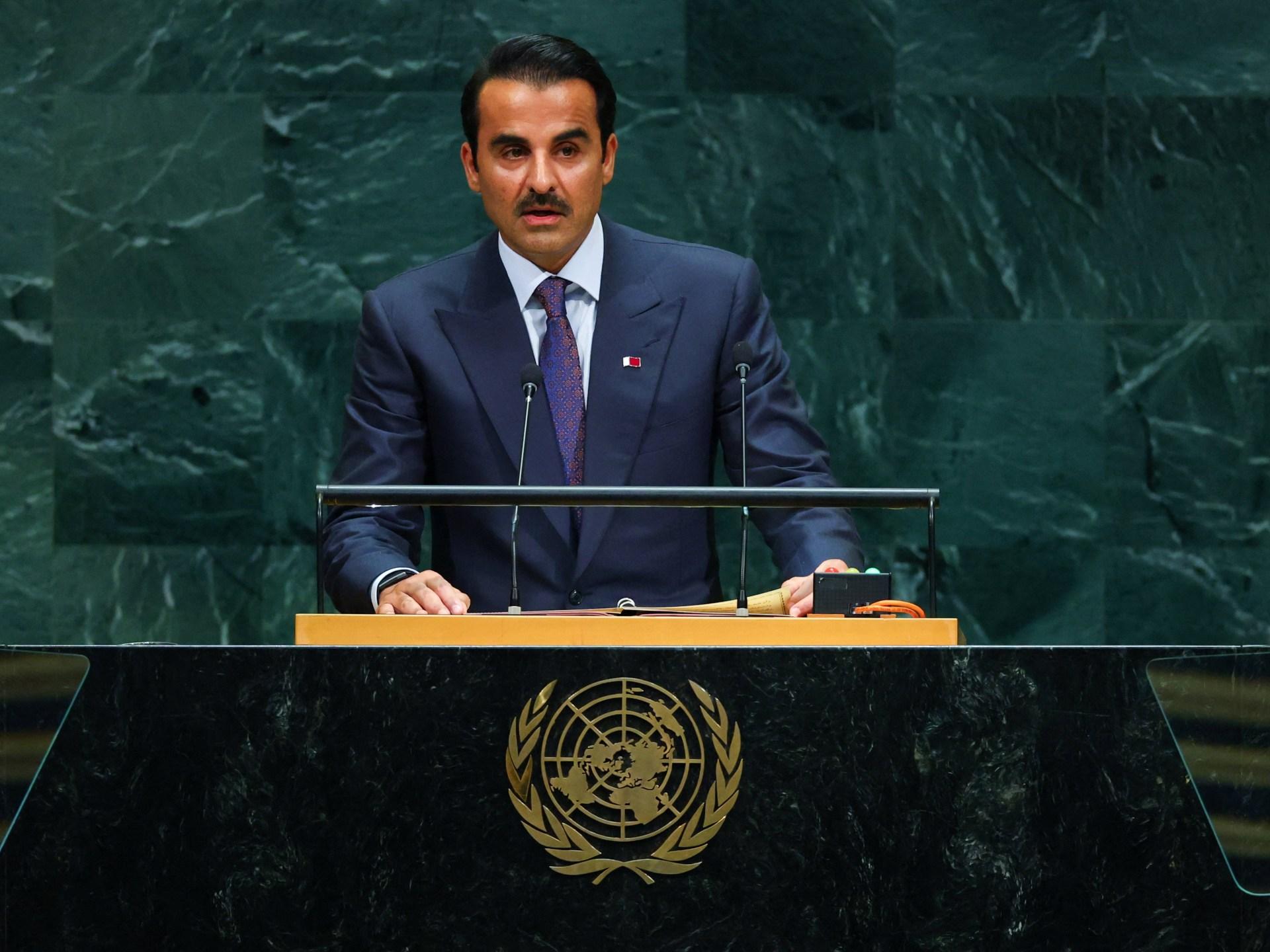
Sheikh Tamim bin Hamad Al Thani, the Emir of Qatar, affirmed in his address to the United Nations General Assembly that the Arabian Peninsula is currently navigating its most perilous phase of conflict due to the US-Israeli war on Iran, calling for a diplomatic resolution to the crisis to ensure the security of the entire region, including Iran. He emphasized the urgent need to reopen the Strait of Hormuz for maritime navigation as a fundamental step to prevent a full-scale war, viewing the current war as an accumulated result of years of delaying political solutions.
Sheikh Tamim stated that Qatar is exerting every effort to address the conflict administratively while remaining steadfast in defending its territory and sovereignty, warning that the absence of a collective regional security system could open the door for wars, as has indeed happened. He noted that Israeli aggression on the occupied West Bank and Gaza Strip has expanded to include neighboring countries, negatively impacting the overall security of the region. He affirmed that a fair international system cannot be discussed while Palestinians suffer a tragedy he described as genocide in all its meanings.
He continued that Qatar's position supports UN efforts to reach a comprehensive political settlement that preserves Yemen's unity, integrity, and sovereignty, achieving security and stability, reaffirming Qatar's support for the sovereignty of Lebanon, Sudan, and Libya. This statement came hours after a meeting described by US President Donald Trump as "very good" with the Iranian delegation, while he had reiterated threats of genocide against Iran in his speech immediately before the meeting.
The address comes amid escalating war risks that have persisted for seven months along the economic supply lines of the Gulf, where the United States and Iran have exchanged strikes on oil tankers and ships in the Strait of Hormuz after Saudi Arabia shut down its East-West oil pipeline in September due to drone attacks originating from Iraq. Additionally, new fighting has erupted in Yemen as the Houthi group advances toward the vital Bab el-Mandeb strait, following US and Israeli strikes on Iran on February 28 amidst nuclear program negotiations that resulted in the killing of the Supreme Leader and hundreds of civilians.
Analysis & context
Analysis & Context
Analytically, Sheikh Tamim's speech highlights Qatar's strategic role as a diplomatic bridge between warring parties in the Middle East. The emphasis on "trusted mediation" reflects an foreign policy strategy based on dialogue to prevent military escalation that could lead to a wide-scale regional catastrophe.
In the broader context, recent developments such as Saudi Arabia's closure of oil pipelines and attacks on ships in the Strait of Hormuz indicate a severe deterioration in economic and regional security. These events validate Qatar Emir's analysis that the lack of a collective security system makes the region vulnerable to reciprocal attacks threatening vital supply lines.
The speech also underscores Qatar's stance rejecting Israeli aggression against Palestine and strongly supporting the national sovereignty of sister nations such as Lebanon, Sudan, Libya, and Yemen. This position reflects a comprehensive regional vision linking the destinies of these countries and affirming that any sustainable solution must respect the rights of peoples and their sovereignty.
Finally, the speech highlights the cumulative nature of the current crisis, which began with February 28 attacks on Iran amidst nuclear negotiations. This historical context illustrates how negotiations transformed into military conflict leading to significant human and material losses in Gulf and Middle Eastern countries.