Sourced fact
The News
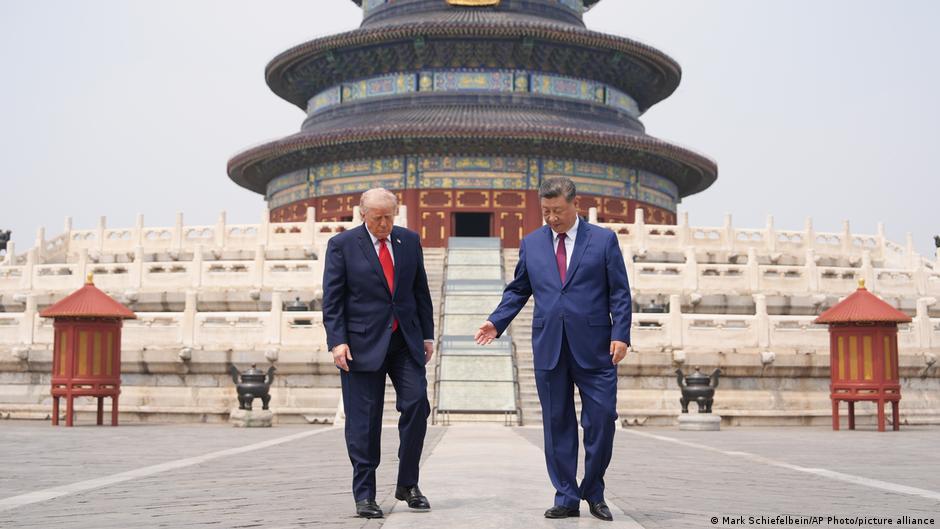
US and Chinese leaders meet in Washington this week to try to ease the ongoing trade war between them, with expectations that these talks will be more productive than the previous summit held in Beijing without achieving concrete results. Observers hope that this round of negotiations will make progress that serves the Republican Party of US President Donald Trump ahead of the midterm elections scheduled for next November, despite no guarantee of a final agreement.
Experts such as Mikko Huotari, director of the German Meriex Institute, indicate that the current situation resembles strategic stalemate where Chinese President Xi Jinping does not need an immediate breakthrough but needs more time just as much as Washington does. Sources from Deutsche Welle confirm that both sides are competing intensely in multiple fields, most notably artificial intelligence, where the US government imposes a ban on exporting high-performance chips to China while Beijing restricts exports of rare earth elements necessary for semiconductor manufacturing.
In Europe, European Commission President Ursula von der Leyen described the current situation as "China's second shock" that has caused restructuring of European industries and threatens further industrial decline in the core industrial regions of the European Union. Berlin called for additional tariffs on cheap Chinese government-subsidized electric vehicles, while China denies having any unfair advantage and calls on German companies such as Volkswagen and BMW to reject the tariffs out of fear of retaliatory Chinese measures.
While Trump pressures his European allies to tighten restrictions on China in technology and security fields, Canadian Prime Minister Mark Carney turns to a "variable engineering" policy based on building different alliances according to shared interests to avoid falling under the sway of great powers. This strategy recently succeeded in reducing Canadian tariffs on Chinese cars from 100% to 6.1% after a visit to Beijing, while China continues its diplomatic efforts with America's shaky allies such as India and Pakistan in preparation for the upcoming G20 summit expected in Miami.
Analysis & context
Analysis & Context
From an analytical perspective, the apparent contradiction between Trump's desire to improve trade relations and his continued threats to his European allies like Canada with tariffs reflects a dual American strategy aimed at isolating China while maintaining Washington's dominance. This approach places middle powers such as Canada and Germany in a difficult position where they must choose between their economic interests with China and the coming security and economic pressure from the United States.
In the broader context, statements by the European Commission President indicate that reliance on Chinese technology has become an existential threat to European industrial sectors, especially with the EU's rapid push toward electric vehicles and reducing carbon dioxide emissions. This transition creates tension between the need for innovation and technology from China and fears of losing economic sovereignty and national security for the European Union.
Similarly, Mark Carney's "variable engineering" strategy reflects a new reality in international relations where middle powers adopt temporary alliances based on shared interests rather than belonging to fixed blocs. This approach allows Canada to negotiate with China and reduce tariffs while trying to avoid Trump's anger who threatens to cancel Canada's membership in the European Union or impose new sanctions.
Finally, competition in the field of artificial intelligence represents a strategic turning point where the US imposes restrictions on exporting high-performance chips to China while Beijing restricts exports of rare earth elements necessary for electronics production. This technological rivalry may lead to a new global division where different countries adopt different standards and aspirations in the fields of artificial intelligence and cybersecurity.